



A prospect in healthcare does not want proof that you are a good MSP. They want proof you are a good MSP for healthcare. Here is how to build case studies that show exactly that.
An MSP should build industry-specific case studies by choosing one vertical at a time, selecting a client whose results address that industry’s specific pressures, and structuring the story around the industry’s own language: its regulations, the software it runs, what downtime costs it, and the business outcome the client cared about. Each case study should include measurable before-and-after results, a quote from the client, a clear explanation of how you worked, written approval from the client, and a dedicated page linked from your matching industry or service page.
Most MSP case studies are written the same way: “Client had old servers and no backups. We migrated them to the cloud and set up monitoring. Now they’re happy.” Swap the client name and it could be any MSP, for any business, anywhere.
That is why they do not persuade. A dental practice owner, a law firm partner or a manufacturing operations manager reading that story learns nothing about whether you understand their world: their compliance rules, their line-of-business software, their busiest season or what an hour of downtime actually costs them.
Industry-specific case studies fix that. They are also some of the most useful content an MSP can publish for search. Google’s guidance on creating helpful, reliable content rewards first-hand experience and original information, and a detailed case study is exactly that. This guide explains how to choose the right industries, find the right client stories, structure the case study, handle confidentiality, and publish it so it ranks and persuades.
Why industry-specific case studies outperform generic ones
They answer the buyer’s real question. Prospects rarely doubt that you can manage IT. They doubt that you understand their industry. A case study from their own sector answers that directly.
They use the prospect’s language. A healthcare prospect searches and thinks in terms of EHR systems, HIPAA and patient scheduling. A generic case study never uses those words. A healthcare case study does.
They support vertical service pages. If you have, or want, pages targeting “IT services for law firms” or “managed IT for dental practices,” case studies give those pages the proof and specific detail they need to rank and convert.
They are more visible in AI search. AI assistants answer questions like “Which Denver IT providers work with healthcare practices?” using specific, published evidence. A case study that names the industry, the location and the outcome is far more likely to be used in that answer than a generic services page. We explain the wider picture in how to get your MSP mentioned in ChatGPT and AI search results.
They shorten sales conversations. Sending a prospect a case study from their own industry mid-cycle answers the objections they have not voiced yet.
Step 1: Choose which industries to build for
Do not try to cover every industry at once. Pick one to three verticals where you already have clients, results and ambition to grow.
Ask four questions:
- Where do we already have several clients? Three or more clients in one industry usually means you have repeatable knowledge.
- Where do our best-fit, most profitable clients come from? Build proof for the clients you want more of.
- Which industries have specific IT pressures we genuinely understand? Regulations, specialist software or unusual uptime needs.
- Is there local demand? In the Denver metro, for example, healthcare, professional services, construction and engineering, and manufacturing all have a strong presence. Pick the sectors where your local pipeline is.
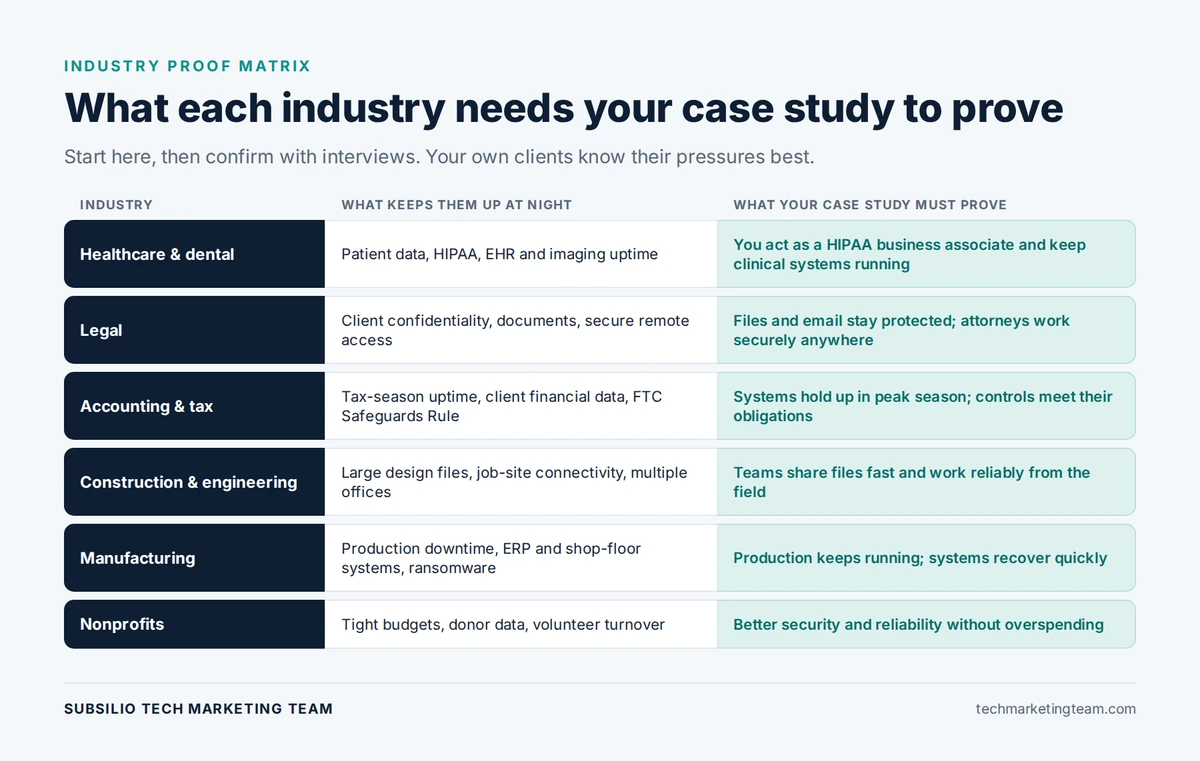
Each industry has different pressures. Your case study should prove you understand the ones that matter to that buyer.
Step 2: Know what each industry actually cares about
An industry-specific case study is only as good as your understanding of that industry. Before you write, list the pressures, systems and outcomes that matter to its buyers.
| Industry | What keeps them up at night | What your case study should prove |
|---|---|---|
| Healthcare and dental | Patient data privacy, HIPAA, EHR and imaging uptime, scheduling | You work as a HIPAA business associate, keep clinical systems running and protect patient data |
| Legal | Client confidentiality, document management, secure remote access | Files and email are protected, attorneys can work securely from anywhere |
| Accounting and tax | Tax-season uptime, client financial data, the FTC Safeguards Rule | Systems stay up in peak season and security controls meet their obligations |
| Construction and engineering | Large design files, job-site connectivity, multiple offices | Teams share files quickly and work reliably from the field |
| Manufacturing | Production downtime, ERP and shop-floor systems, ransomware | Production keeps running and systems recover quickly |
| Nonprofits | Tight budgets, donor data, volunteer turnover | Better security and reliability without overspending |
Treat the table as a starting point. Interview your own clients in each industry, because the best insights come from them, not from research.
Step 3: Pick the right client story
The best case study is not always your biggest client. It is the one whose story will resonate most with the prospects you want.
Look for:
- A clear, relatable problem that other businesses in the industry face
- Measurable before-and-after results
- A client who is happy and willing to be quoted
- Something specific to the industry, not just a generic migration
- A decision-maker who matches your target buyer
Where to find stories: your QBRs are the richest source, because they already document goals, outcomes and results. We explain how to capture that material in turning QBRs into marketing assets for your MSP. Project retrospectives, onboarding wins and incident recoveries are also strong candidates.
Step 4: Get consent and handle confidentiality
Get this right before you write, not after.
- Ask for permission early and explain exactly how the case study will be used.
- Offer three levels: named with logo, named without detail, or fully anonymized (“a 40-person Denver accounting firm”).
- Check your contract. Many master services agreements restrict publicity. Add a clause allowing it with written permission.
- Never publish security details that would help an attacker: specific vulnerabilities, unpatched systems, exact tools that reveal their stack, or incident details.
- Get written approval of the final text, and keep it on file.
- Keep it honest. The FTC’s Endorsement Guides require endorsements to reflect honest opinions and actual experience, and say that if an endorser’s results are not what people would generally achieve, the ad must make clear what they can generally expect.
Regulated clients deserve extra care. A healthcare, legal or financial client will often need its own compliance contact to review the case study before it is approved.
Step 5: Interview the client
A 20 to 30 minute call produces better material than any questionnaire. Ask open questions and record the answers, with permission.
Questions that produce strong case studies:
- What was happening in your business before you started working with us?
- What made you decide to change IT providers, or bring in an MSP?
- What worried you most about making the change?
- What specific problems has working with us solved?
- What has changed for your team day to day?
- Can you remember a moment when you knew it was working?
- What would you tell another [industry] business considering a change?
Question 7 often produces the best quote, because the client speaks directly to your next prospect.
Step 6: Structure the case study
Use the same structure for every case study so readers can scan them and compare. This structure also makes each one easy for search engines and AI tools to understand.
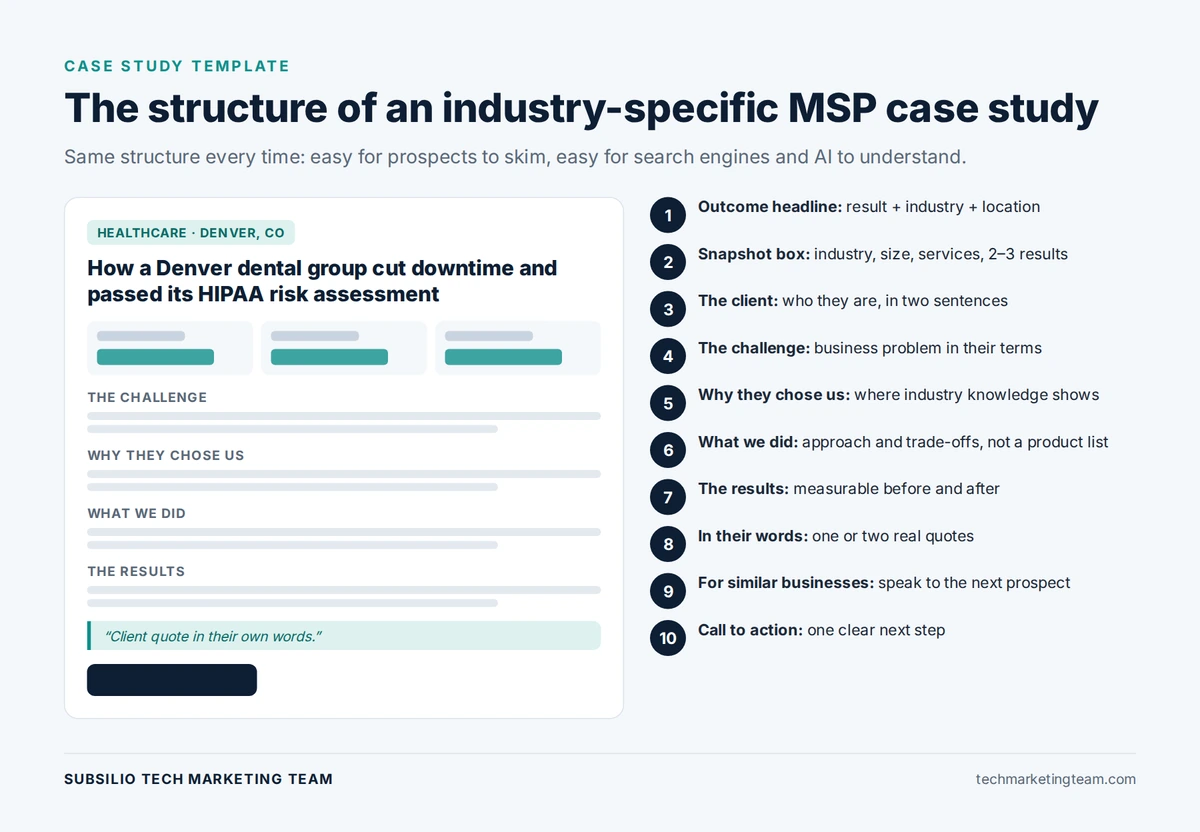
A repeatable case study structure, built for skimming prospects and for search.
- Outcome headline. Lead with the result and the industry: “How a Denver dental group cut system downtime and passed its HIPAA risk assessment.”
- Snapshot box. Industry, location, size, services provided, and two or three headline results.
- The client. Two or three sentences on who they are and what they do.
- The challenge. The business problem in the client’s terms, including the industry-specific pressures.
- Why they chose us. What made them trust you. This is where the industry understanding shows.
- What we did. The approach and phases, in plain language. Explain decisions and trade-offs, not a list of products.
- The results. Measurable before-and-after outcomes, tied to business impact.
- In their words. One or two strong quotes from the client.
- What this means for similar businesses. A short paragraph speaking directly to prospects in the same industry.
- Call to action. A clear next step, such as a consultation.
Write results in business terms
The results section is where most MSP case studies go vague. Compare these:
| Weak | Strong |
|---|---|
| “Improved security posture” | “Rolled out multi-factor authentication to all 42 users in two weeks, with no disruption to patient scheduling” |
| “Reduced downtime” | “Unplanned downtime fell from several hours a month to under one” |
| “Faster support” | “Average response time to urgent tickets fell to under 15 minutes” |
| “Modernized infrastructure” | “Moved file storage to the cloud so project managers can open drawings from job sites” |
Use real numbers from your PSA, RMM and QBR reports. Never invent or round numbers up to sound better. If you do not have a baseline, describe the change qualitatively and honestly.
Step 7: Publish it where prospects and search engines will find it
Give every case study its own page. Not a PDF behind a form. A dedicated, indexable page with a descriptive URL, such as /case-studies/denver-dental-group-it/.
Link it from the matching pages. From the industry page, the relevant service page (for example your cybersecurity or managed IT services pages), and your location pages where it is a local client. Our guide to MSP website architecture explains how to structure these connections.
Make it answerable. Put a short summary of the challenge and outcome at the top, use clear headings, and include a short FAQ. This helps AI tools extract and cite it. See answer-first FAQ content for MSPs.
Add structured data. Article markup with the author and date, plus organization details, helps search engines understand the page. Our MSP schema markup guide covers what to use.
Include real images. Photos of the client’s team or office (with permission), or clear diagrams of the before-and-after setup. Avoid stock photos of server rooms.
Keep it honest in the metadata too. Google’s review snippet guidelines say that when a business controls the reviews about itself, pages using LocalBusiness or Organization structured data are not eligible for review stars. Do not add review markup to a case study hoping for stars.
Want case studies that win business in your target industries?
Talk to us. We help MSPs interview clients, write industry-specific case studies and publish them where prospects will find them.
Step 8: Put every case study to work
A case study that sits on your website unread is a wasted asset. Use each one in at least five places:
- Sales follow-up. Send it to prospects in the same industry after a first call.
- Proposals. Include a one-page summary in every proposal for that vertical.
- Service and industry pages. Pull the headline result and quote onto the relevant page. See review walls and trust sections for MSP websites.
- Social media and LinkedIn. Break it into several posts: the challenge, the result, the quote.
- Paid ads. Industry-targeted ads that lead to a matching case study usually convert better than ads that lead to a generic homepage.
- Email nurture. Send it to prospects who are not ready yet.
- Content ideas. The questions that came up in the case study often become strong blog topics. See MSP content briefs by buyer stage.
How many case studies does an MSP need?
Start with one strong case study for each target industry. Then aim to add one every quarter. Three case studies in one vertical is usually enough to show a pattern and support a dedicated industry page. Quality matters far more than quantity: one detailed, specific story beats five generic ones.
Common mistakes to avoid
- Leading with your tools instead of their outcome. Prospects care about results, not your stack.
- Writing in jargon. If the client’s office manager could not follow it, rewrite it. We explain why in managed IT services pages that explain outcomes, not jargon.
- No numbers. “Improved performance” means nothing.
- No client voice. Without a quote, it reads like an ad.
- Hiding it behind a form. Search engines and AI tools cannot read what they cannot reach.
- Sharing security details. Protect the client first, always.
- Publishing without written approval.
The bottom line
Generic case studies tell prospects you are an MSP. Industry-specific case studies tell them you are the right MSP for them. That difference is often what moves a healthcare practice, law firm or manufacturer from comparing providers to booking a call.
Pick one to three industries. Understand what keeps those buyers up at night. Find the client story that proves you solve it, get consent, interview the client, and structure the case study around measurable business outcomes and their own words. Then publish it on its own page and use it everywhere your prospects are.
If you want help building case studies that win clients in your target industries, contact our team. We work only with IT service providers and MSPs, and our SEO and website services are built to put this kind of proof in front of the right buyers.
Read next: Turn QBRs into marketing assets for your MSP
Build Case Studies That Win Clients
We help MSPs turn real client results into industry-specific case studies that rank, persuade and shorten the sales cycle.
Frequently Asked Questions
What is an industry-specific case study for an MSP?
It is a detailed story of how an MSP solved a client’s IT problem, written for prospects in the same industry. It uses that industry’s language, addresses its specific pressures such as regulations, specialist software and downtime costs, and shows measurable business results.
Why should MSPs create industry-specific case studies?
Because prospects want proof you understand their industry, not just IT. Industry-specific case studies answer that directly, support vertical service pages in search, give AI tools specific evidence to cite, and help shorten sales conversations.
What should an MSP case study include?
An outcome-focused headline, a snapshot of the client and results, the challenge, why the client chose you, what you did, measurable results, a client quote, what it means for similar businesses, and a clear call to action.
How long should an MSP case study be?
Most effective case studies run between about 600 and 1,200 words: long enough to show real detail and results, short enough to read in a few minutes. A snapshot box at the top lets busy readers get the key points in seconds.
Can I write a case study without naming the client?
Yes. Anonymized case studies, such as “a 40-person Denver accounting firm,” can still be very persuasive if they include specific industry detail, real results and a quote. Many clients who would not agree to being named will agree to an anonymized version.
How do I get clients to agree to a case study?
Ask at a natural moment, such as after a QBR where the client has agreed the results were strong. Explain how it will be used, offer anonymity, and promise that they approve every word before it is published. Keep the interview short and easy.
Should MSP case studies be gated behind a form?
Usually not. A gated PDF cannot be read by search engines or AI tools, and many prospects will not fill in a form to read a case study. Publish the full case study as a web page, and offer a downloadable version as an extra if you want.
How many case studies does an MSP need?
Start with one strong case study for each industry you want to grow in, then add one per quarter. Around three in a single industry is usually enough to show a pattern and support a dedicated industry page.