



Your quarterly business review is the one meeting where a client sees your value laid out in full. Here is how to design it so it also produces reviews, testimonials, case studies and referrals.
An MSP turns QBRs into marketing assets by designing the review so it produces proof as a by-product. That means leading with business outcomes rather than ticket counts, capturing the client’s own words about the value they received, asking for a review or testimonial at the moment the value is clearest, getting written consent before any client detail is used publicly, and turning the QBR’s before-and-after results into a case study or referral conversation. Done well, the QBR stays a client-first meeting and becomes your most reliable source of marketing material.
Most MSPs already run QBRs. Few get anything from them beyond a renewal. The deck gets presented, the client nods, and the evidence of everything you achieved that quarter goes back into a shared drive.
That is a waste of the most credible marketing material you will ever have. A QBR is the only time a client formally reviews what you have done for them, with numbers, in their own business terms. Prospects do not trust what an MSP says about itself. They trust what its clients say. The QBR is where clients say it.
This guide shows how to redesign your QBR so it builds the relationship first and produces marketing assets second: the agenda, the moments to ask, the consent process, scripts, and what to do with the material afterward.
What a QBR can produce for your marketing
A well-run QBR can produce six kinds of asset. You will not get all six from every meeting, and you should not try.
| Asset | Where it comes from in the QBR | Where it gets used |
|---|---|---|
| Google review | The client’s reaction to the results section | Google Business Profile, local search, AI answers |
| Written or video testimonial | The client’s own words about the value they received | Website, proposals, service pages, ads |
| Case study | Before-and-after metrics plus a project retrospective | Industry pages, sales follow-up, LinkedIn |
| Referral or introduction | A natural question once value is agreed | New business pipeline |
| Anonymized data and insights | Trends across several clients’ QBRs | Blog posts, reports, AI-visible content |
| Expansion opportunity | The roadmap section | Account growth, which funds marketing |
The anonymized data route, turning QBR findings into public blog content, is covered in our guide to turning MSP tickets, QBRs and vCIO notes into SEO content. This article focuses on the other five: the assets that come from the client directly.
Why most MSP QBRs produce nothing worth using
Before you can turn a QBR into a marketing asset, the QBR has to be worth talking about. Four problems stop most of them.
They report activity, not outcomes. “We closed 214 tickets and patched 96 percent of endpoints” is activity. “Your team lost about half the downtime it did last year, and the new laptops cut onboarding from three days to one” is an outcome. Clients remember outcomes and repeat them to others.
They are a technical monologue. If your engineer presents for 45 minutes and the client’s operations director checks email, nobody leaves with anything to say about you.
They never ask how the client feels. Most QBR decks are all your data and none of their opinion. Without the client’s own words, you have nothing to quote.
They end with a sales pitch. A roadmap that is really a list of things to buy damages trust and makes the client less likely to endorse you.
Fix these, and the marketing assets tend to follow.
The QBR agenda that builds the relationship and produces proof
This agenda keeps the meeting client-first. Each section has a clear business purpose, and each one naturally creates a different kind of asset.
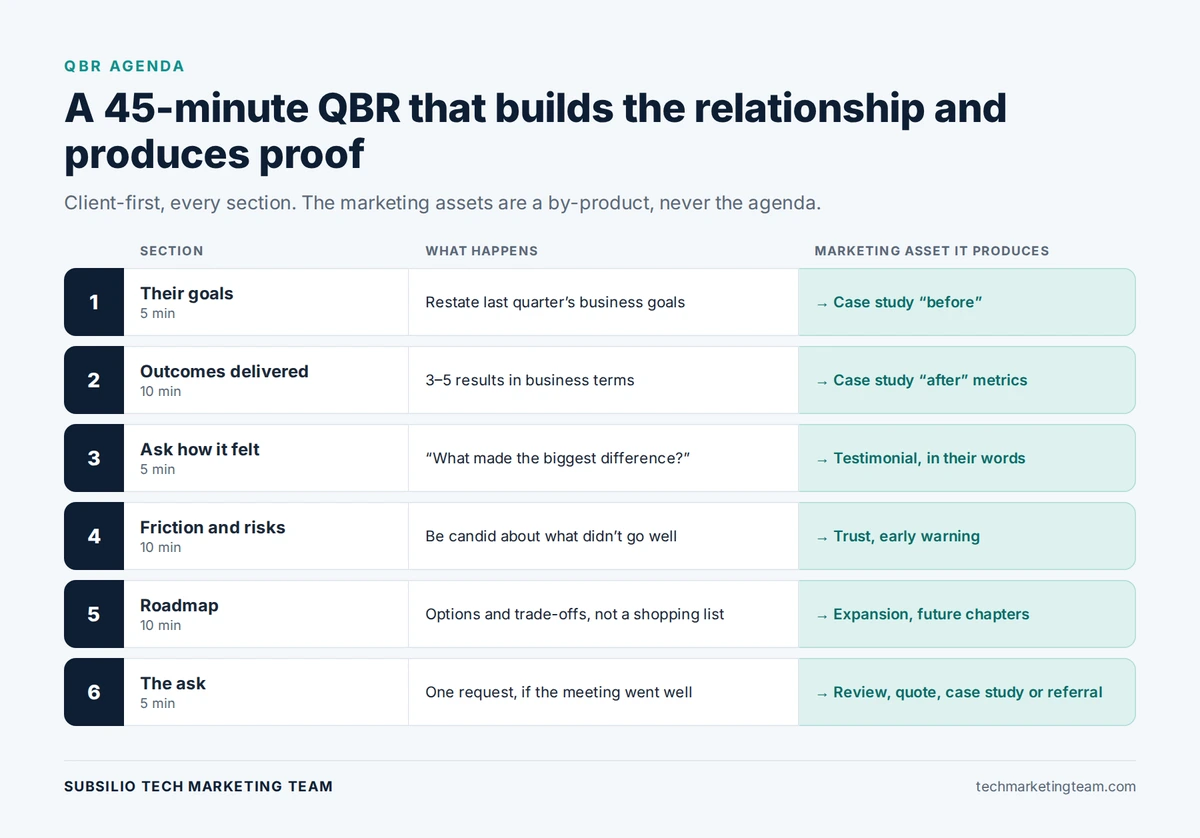
A QBR agenda designed so each section produces something you can use, with the client’s permission.
1. Their goals, not your metrics (5 minutes)
Open by restating the business goals the client shared last quarter: hiring, a new office, a compliance audit, moving to the cloud. This frames everything that follows in their terms.
Asset created: the “before” half of a future case study.
2. Outcomes delivered (10 minutes)
Show three to five outcomes tied to those goals. Translate every technical metric into business language: time saved, downtime avoided, risk reduced, a project delivered on schedule. Where you can, compare with the same period last year.
Asset created: the “after” metrics for a case study, and the moment the client is most likely to say something quotable.
3. Ask how it felt (5 minutes)
Ask one open question and then stop talking: “Looking back at this quarter, what’s made the biggest difference for your team?” Write down the answer word for word.
Asset created: the raw material for a testimonial, in the client’s own language.
4. Friction and risks (10 minutes)
Cover what did not go well, open risks and security gaps. Be candid. Clients trust MSPs that raise problems before they are asked. This is also where you catch frustrations before they turn into a negative review. We explain why that matters in how MSPs should respond to negative reviews.
Asset created: trust, and early warning.
5. Roadmap (10 minutes)
Agree the priorities for the next two to four quarters, tied to their goals. Present options with trade-offs, not a shopping list.
Asset created: expansion opportunities, and future case study chapters.
6. The ask (5 minutes)
If the meeting has gone well and the client has said something positive about the value, this is the moment to make one request: a review, a testimonial, permission to write a case study, or an introduction. One, not all four.
Asset created: whichever one you ask for.
When and how to ask during a QBR
The best moment to ask is right after the client has agreed, out loud, that the quarter went well. Not before the results, and not in a follow-up email three weeks later.
Choose one ask per QBR. Rotate them across the year. A client who is asked for a review in Q1, a testimonial quote in Q2 and a referral in Q3 feels appreciated. A client asked for all three in one meeting feels sold to.
Match the ask to the relationship:
- Newer clients (first year): a Google review
- Established clients: a written or video testimonial
- Clients with a strong before-and-after story: a case study
- Long-term, happy clients: a referral or introduction
Ask every client, not just the happiest ones. If you only ask the clients you expect to rave, you are selectively soliciting positive reviews, which Google’s review policies prohibit. The QBR ask for a Google review should be a standard step for every client, whatever their mood.
QBR ask scripts
Google review:
“Thanks for that feedback, it genuinely means a lot to the team. Most businesses find us by reading what our clients say on Google. Would you be willing to share an honest review? I’ll send you the link after this call so it only takes a couple of minutes.”
Testimonial:
“What you said earlier about onboarding going from three days to one really stood out. Would you be comfortable with us using that as a short quote on our website? I’ll write it up exactly as you said it and send it to you to approve first.”
Case study:
“The results from the office move are a great example of what we try to do for clients. Would you be open to us writing it up as a case study? You’d approve every word, and we can leave your company name out if you prefer.”
Referral:
“We grow mostly through introductions from clients like you. Is there anyone in your network, maybe another business owner in Denver or Arvada, who you think we could help in the same way?”
Google provides a direct review link and QR code from your Business Profile. Its help page explains how to create a link or QR code to request reviews. Have it ready to send the moment the call ends.
Consent and confidentiality: do this before anything goes public
A QBR is full of confidential information: security gaps, budgets, incidents, staff issues. None of it can appear in your marketing without explicit, written permission.
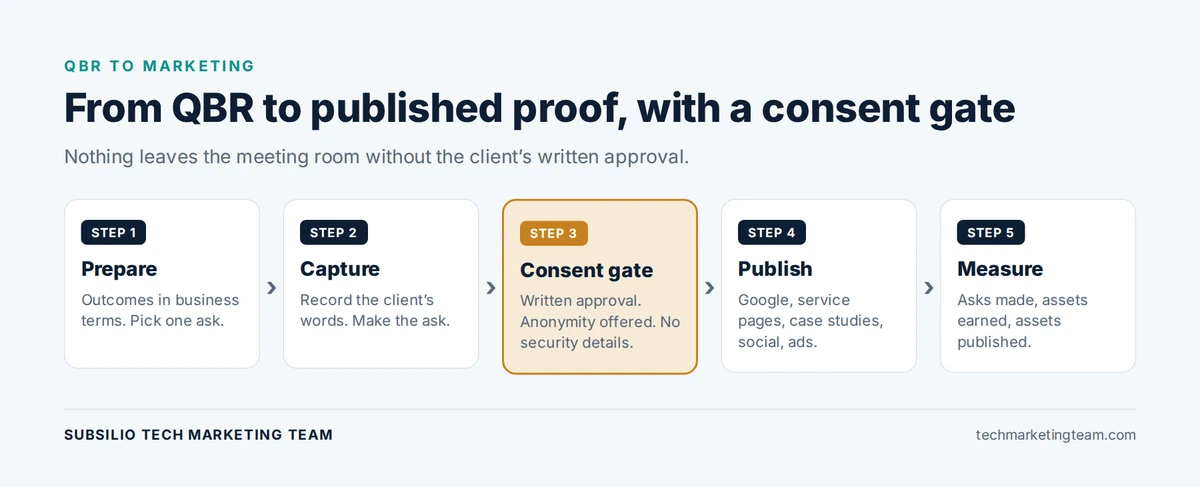
Nothing moves from the QBR into your marketing without passing the consent gate.
Get written approval for every public use. Email the exact quote, review draft or case study text and ask for a written “approved.” Keep that email on file.
Check the contract. Many master services agreements restrict publicizing the relationship. If yours does not already include a clause allowing you to name the client with permission, add one at renewal.
Offer anonymity. “A 45-person Arvada engineering firm” is still persuasive. Many clients will agree to an anonymized case study who would never agree to a named one.
Never reveal security details. No vulnerability specifics, tool names that expose their stack, incident details or anything that helps an attacker. Describe outcomes, not weaknesses.
Take extra care with regulated clients. HHS guidance on HIPAA business associates lists a managed services provider supporting a covered entity’s systems as an example of a business associate. Healthcare, legal and financial clients will each have their own confidentiality expectations, so involve their compliance contact early.
Keep testimonials honest. The FTC’s Endorsement Guides require endorsements to reflect the endorser’s honest opinion and actual experience. Do not rewrite a client’s words into something stronger than they said, and if you gave them anything of value in connection with the testimonial, that connection may need to be disclosed.
What to do with the assets after the QBR
Collecting proof is half the work. Most MSPs lose the value by not putting it anywhere a prospect will see it.
Google reviews support local visibility. Google says more reviews and positive ratings can help your local ranking. Reply to each one. Our Google Business Profile operating checklist for MSPs covers the rest of the profile.
Testimonials belong beside the claim they support, not on a single testimonials page. A quote about fast onboarding goes on your managed IT page; a quote about an incident goes on your cybersecurity page. We explain this in review walls and trust sections for MSP websites and in turning testimonials into sales.
Case studies work best when they are specific to an industry. A dental practice wants to see how you helped a dental practice. See how MSPs should build industry-specific case studies.
Short quotes and results make strong social media posts and ad creative, with permission.
Referrals need a fast, personal follow-up. Thank the client, contact the introduction within a day, and tell the client how it went.
Want your QBRs producing proof every quarter?
Talk to us. We help MSPs turn client results into reviews, testimonials and case studies that win new business.
Build it into your QBR process so it happens every time
Good intentions last one quarter. A process lasts. Add these steps to your QBR checklist:
| When | Step | Owner |
|---|---|---|
| Two weeks before | Pull outcomes and translate them into business terms | vCIO or account manager |
| One week before | Decide the one ask for this client this quarter | Account manager |
| During | Ask the “biggest difference” question and record the answer word for word | Account manager |
| During | Make the ask, if the meeting has gone well | Account manager |
| Same day | Send the review link, or the draft quote or case study for approval | Account manager |
| Within a week | Store approvals, publish approved assets, log referrals | Marketing lead |
| Monthly | Review which clients have been asked for what, and plan next quarter’s asks | Marketing lead |
Track three numbers: the percentage of QBRs that include an ask, the percentage of asks that produce an asset, and how many assets are actually published. The third is where most MSPs fall down.
Local context: why this matters for Denver and Arvada MSPs
In a competitive metro like Denver, many prospects will shortlist several IT providers that look similar on paper. Reviews and case studies from recognizable local businesses are one of the few things that genuinely set one MSP apart from another. An anonymized case study about “a 30-person Arvada manufacturer” or “a Denver law firm with two offices” tells a local prospect you already understand businesses like theirs. That local proof also supports your location pages with real, specific content instead of generic copy.
The bottom line
Your QBR is already the most credible evidence of your value that exists. The difference between an MSP that grows through reputation and one that does not is often just whether that evidence leaves the meeting room.
Lead with business outcomes. Ask the client how it felt and write down the answer. Make one well-timed ask. Get written consent before anything goes public. Then put the proof where prospects will see it: your Google profile, your service pages, your case studies and your sales conversations.
If you want help turning client results into marketing that brings in new business, contact our team. We work only with IT service providers and MSPs, and our reputation marketing service is built to capture exactly this kind of proof.
Read next: How MSPs should build industry-specific case studies
Turn Client Results Into New Business
We help MSPs capture reviews, testimonials and case studies from the work they already do, and put that proof in front of the right prospects.
Frequently Asked Questions
What is a QBR for an MSP?
A quarterly business review is a scheduled meeting, usually every three months, where an MSP reviews the past quarter with a client: service performance, outcomes delivered, risks, and a technology roadmap tied to the client’s business goals. It is the MSP’s main tool for showing value and strengthening the relationship.
Can a QBR be used for marketing?
Yes, if the client comes first. A QBR naturally produces the raw material for reviews, testimonials, case studies and referrals because it documents real results. The key is to keep the meeting client-focused, make one appropriate request, and get written consent before any detail is used publicly.
When should an MSP ask for a review during a QBR?
Right after the client has agreed that the quarter went well, usually at the end of the outcomes discussion or the close of the meeting. Send the Google review link immediately after the call. Ask every client as a standard step rather than only the ones you expect to be positive.
What should an MSP QBR include?
The client’s business goals, three to five outcomes delivered in business terms, the client’s own view of what made a difference, open risks and friction, and a roadmap for the next few quarters. Avoid long ticket statistics and product pitches.
How do I turn a QBR into a case study?
Use the client’s original goals as the challenge, the outcomes section as the results, and the client’s own words as the quote. Get written approval for the final text, offer an anonymized version, and never include security details. Industry-specific case studies tend to persuade prospects in the same sector best.
Do I need client permission to use QBR information in marketing?
Yes. Anything that identifies the client or reveals details from the QBR needs explicit, written approval. Check your master services agreement for publicity restrictions, and take extra care with healthcare, legal and financial clients, who often have their own confidentiality obligations.
How often should MSPs run QBRs?
Quarterly is the standard for managed clients. Some MSPs run lighter reviews for smaller clients twice a year and full QBRs for larger or strategic accounts. What matters for marketing is consistency: every review is a chance to capture proof.
Should I offer clients something in exchange for a testimonial?
Be careful. Google prohibits incentives for reviews entirely. For testimonials used in your own marketing, the FTC’s Endorsement Guides say material connections that people would not expect may need to be disclosed. The simplest approach is to ask without offering anything in return.