



Almost every MSP website has an FAQ section. Almost none of them answer anything.
The typical example runs something like this. Question: “Why should we choose you as our IT partner?” Answer: three paragraphs about a commitment to excellence, a proactive approach, and treating clients like family. Nobody asked that question. Nobody reads that answer. And when a search engine or an AI assistant scans the page looking for something quotable, there is nothing to take.
This matters more in 2026 than it did three years ago, and for a reason most MSP marketing content has not caught up with. Search has shifted from returning pages to returning answers. AI assistants, AI Overviews and conversational search all work by extracting passages that stand on their own and stitching them into a response. Content that answers a question in the first sentence gets extracted. Content that builds to a conclusion over four paragraphs does not.
Answer-first FAQ content is the cheapest way for an MSP to become extractable. This guide covers how to write it, where to put it, and the schema question that almost everyone is now getting wrong.
What “answer-first” actually means
Answer-first means the direct answer occupies the first sentence, and everything after it is elaboration that a reader can stop at any point without losing the answer.
It is the inverse of how most marketing copy is written, which builds context first and arrives at the point last.
Before:
How much does managed IT support cost?
Every business is different, and we believe in creating a custom solution tailored to your unique requirements. Pricing depends on a wide variety of factors including the size of your organisation, your industry, your existing infrastructure and your compliance obligations. That is why we start every engagement with a free consultation, where we take the time to understand your business before recommending a plan.
Two hundred and fifty characters of throat-clearing and no number. A reader learns nothing. An AI system has nothing to cite.
After:
How much does managed IT support cost?
Most small and mid-sized businesses pay between $100 and $200 per user per month for fully managed IT support in the US, with per-device and tiered models also common. The main variables are user count, the level of cybersecurity included, whether on-site visits are covered, and your compliance requirements. Co-managed arrangements, where we work alongside an internal IT person, typically fall below that range.
The second version answers the question, then qualifies it. It is also harder to write, because it requires committing to something. That difficulty is the filter , it is exactly why so few MSP sites do it, and exactly why the ones that do get quoted.
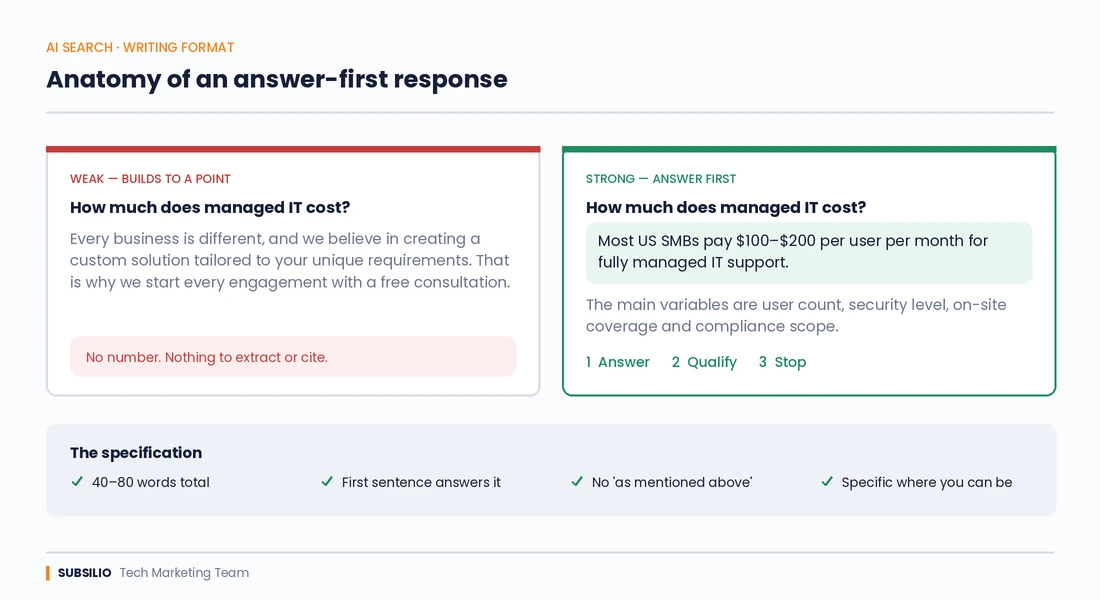
Side-by-side comparison of a weak marketing FAQ answer and an answer-first response, with the 40 to 80 word specification.
Why this format works in AI search
Three mechanical reasons, none of them mysterious.
Passage independence. AI retrieval systems pull chunks of text, not whole pages. A chunk that contains a complete question and a complete answer makes sense in isolation. A chunk from the middle of a flowing narrative does not, so it is less likely to be selected.
Explicit question matching. Conversational queries are phrased as questions. A page containing the literal question, formatted as a heading, matches more cleanly than a page where the same information is buried in prose.
Verifiability. Systems that generate answers prefer sources they can attribute confidently. A specific, self-contained, checkable claim is a safer citation than a vague one.
None of this requires special technology. It requires writing the answer first.
The structure of a good answer
A workable specification, refined across a lot of MSP pages:
- Length: 40 to 80 words. Long enough to be complete, short enough to be lifted whole.
- First sentence answers it. If a reader stopped there, they would have what they came for.
- Second and third sentences qualify. Conditions, exceptions, variables.
- No pronouns referring outside the answer. “This depends on that” is useless in isolation. Name the thing.
- No cross-references. “As mentioned above” breaks the moment the passage is extracted.
- Specific where you can be. A range beats “it depends”. A timeframe beats “quickly”.
- The question is phrased the way a buyer would ask it, not the way you would market it.
| Weak answer | Strong answer |
|---|---|
| “Response times vary depending on severity.” | “Critical issues are acknowledged within 15 minutes and worked continuously until resolved. Standard requests are acknowledged within one business hour.” |
| “We take security very seriously.” | “Every managed plan includes endpoint detection and response, managed patching, email filtering, and quarterly vulnerability scanning. Penetration testing and SIEM are available as add-ons.” |
| “Contracts are flexible to suit your needs.” | “Our standard agreement runs 12 months with a 60-day termination clause. Month-to-month is available at a 15 per cent premium. We do not use automatic multi-year renewals.” |
| “We serve businesses of all sizes.” | “We work best with organisations of 20 to 250 users. Below 20, a break-fix arrangement is usually better value. Above 250, you generally need a co-managed model.” |
Notice what the strong column requires: you have to know your own business and be willing to publish it. Half of the work in building good MSP FAQs is internal decision-making, not writing.
Where FAQs belong, and where they do not
Three valid placements, each doing a different job.
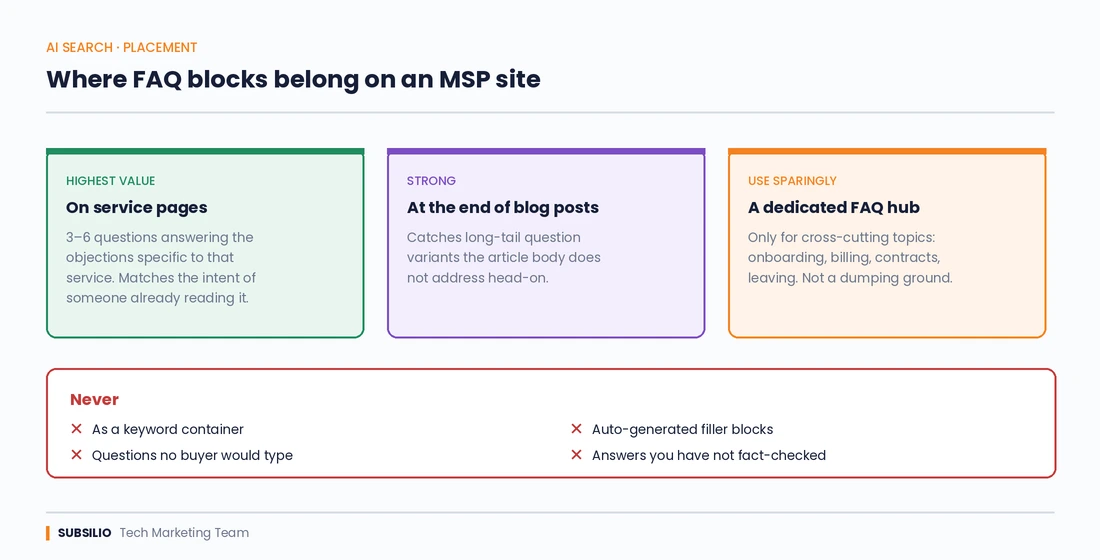
Map of where FAQ blocks belong on an MSP website: service pages, blog posts and a sparing FAQ hub.
On service pages. The highest-value placement. Three to six questions at the bottom of a service page, answering the objections specific to that service. On a cybersecurity page: what happens if we get breached anyway, do you carry insurance, who owns the tooling. Our guides to cybersecurity service pages that rank and convert and managed IT services pages that explain outcomes cover how these sections fit into the wider page.
At the end of blog posts. Catches the long-tail question variants the article body does not address head-on, and gives retrieval systems clean extractable passages on a page that is already topically focused.
As a dedicated FAQ hub, sparingly. Useful for genuinely cross-cutting questions: onboarding, billing, contracts, what happens if we want to leave. Not a dumping ground. A hub of 60 unorganised questions is worse than three well-placed sets of six.
Where they do not belong: as a keyword container. Adding “What is the best IT support in Denver?” to a page so the phrase appears is the behaviour that got the format devalued in the first place.
Finding the questions people actually ask
The best MSP FAQ content is not researched in a keyword tool. It is transcribed from places where real questions already exist.
- Sales call recordings and notes. The objection that comes up in every third discovery call is your highest-value FAQ, and it is being answered verbally dozens of times without ever being written down.
- Your ticket system. Recurring client questions indicate recurring prospect questions. Our guide to turning tickets, QBRs and vCIO notes into SEO content covers the extraction process in detail.
- Search Console query data. Filter the Queries report for question words , how, what, why, should, does, can. These are terms you already appear for, meaning demand is confirmed.
- The Q&A section of your Google Business Profile. Real prospects, real questions, frequently unanswered.
- Your onboarding and offboarding conversations. The questions a client asks in week one are the questions a prospect was too polite to ask.
- Ask your technicians what clients keep asking them. Nobody surveys the service desk and they hold the best material in the company.
Then pass every candidate through one filter: Would a buyer type this? “What are the benefits of managed IT services?” is a marketing question. “Is managing IT cheaper than hiring an IT person?” is a buyer’s question. Write the second one.
The questions MSPs avoid
The most valuable FAQ content is the content your competitors will not publish, because publishing it involves commitment.
- What does it actually cost, in a range
- What is the minimum contract term
- What happens to our data and documentation if we leave
- Is your support team based in this country
- What is excluded from the monthly fee
- What happens if you miss your response time commitment
- Do you work with our existing line-of-business software
- Who owns the licences, you or us
Every one of these is asked in sales conversations. Almost none appear on MSP websites. Answering them openly does three things simultaneously: it ranks for high-intent queries nobody has covered, it gives AI systems something specific to quote, and it disqualifies bad-fit prospects before they take up an hour of your time. That last one is often worth more than the traffic.
The schema question, answered correctly
This is where most current advice is out of date, and stating it accurately is a credibility signal in itself.
Google retired FAQ rich results on 7 May 2026. The expandable question dropdowns no longer appear in Google Search for any website, including the government and health sites that retained eligibility after the August 2023 restriction. Google is removing the FAQ search appearance filter and Rich Results Test support, with Search Console API support ending later in the year. Google’s FAQPage structured data documentation carries the deprecation notice.
What this means in practice:
- FAQPage is still a valid Schema.org type. The markup is not banned and it will not harm your site. Google has said unused structured data does not cause problems in Search.
- It is no longer a SERP tactic. If your FAQ schema existed to win extra pixels and click-through rate, that use is finished.
- Other engines and AI crawlers still parse structured data. Keeping clean, accurate FAQPage markup on genuinely useful Q&A content is reasonable. Treating it as a guaranteed route into AI citations is not, and anyone promising that is overselling.
- Do not rush to strip it out. Remove it where it wraps auto-generated filler. Keep it where it describes real, maintained questions.
- Export your historical FAQ performance data before the reporting is fully withdrawn, if you want the comparison later.
The strategic reading: the visible Q&A content on the page is now doing all of the work, and the markup around it is hygiene rather than leverage. That should not change what you write. It should change what you expect from schema. Our MSP schema markup guide covers the structured data types that still carry real weight for IT providers.
A simple production process
- Collect 40 to 60 real questions from the sources above. One sitting, no filtering.
- Group them by the page they belong to. Most will map to a service page.
- Cut to the six best per page. Highest buyer intent, not highest search volume.
- Answer each in 40 to 80 words, answer first, with someone who actually knows the answer.
- Have an engineer or the service delivery lead check every factual claim. Publishing a wrong response-time commitment is worse than publishing none.
- Mark up with FAQPage where the content is genuine. Skip it where it is not.
- Review quarterly. An FAQ that states a contract term you changed last year is an active liability.
Step five is the E-E-A-T step and it is the one most often skipped. Questions answered by a marketing writer working from a competitor’s website produce answers that are plausible, generic and occasionally wrong. Questions answered by the person who runs service delivery produce answers nobody else has.
Measuring whether it is working
Traditional metrics first: impressions and clicks on question-shaped queries in Search Console, filtered for how, what, why, should, does and can. Track the set before and after.
Then AI visibility, which needs its own method. Query the assistants your buyers use with the questions you have answered, and record whether your site is cited. Do it monthly, same prompts, logged in a sheet. It is manual and imprecise, and it is still more informative than assuming. Our guide to measuring MSP SEO and AI visibility with GSC and GA4 covers building the reporting views.
The commercial signal worth watching: sales calls where the prospect arrives already knowing your pricing model and contract terms. That means the content did its job before anyone picked up a phone.
The summary
Answer-first FAQ content is not a formatting trick. It is a commitment to saying specific, checkable things about how your business works, in the place where buyers and machines are both looking.
The MSPs who benefit are the ones willing to publish their price range, their contract terms and their exclusions while their competitors publish paragraphs about being passionate. The format is easy. The candour is the hard part, and it is the entire advantage.
Want this built properly?
We build answer-first content structures for IT providers and MSPs, from question research through to the service pages and schema that carry it.
Explore our MSP SEO services, read more on the Tech Marketing Team blog, or book a free strategy call.
What is answer-first content?
Answer-first content places the direct answer in the opening sentence, with any qualification following afterwards. It inverts standard marketing structure, which builds context first and reaches the point last. The format matters because AI assistants and search engines extract self-contained passages, so an answer that only makes sense after three paragraphs of setup is unlikely to be selected or cited.
Does FAQ schema still help SEO in 2026?
FAQ schema no longer produces rich results in Google Search. Google retired the FAQ rich result on 7 May 2026, ending eligibility for every website. FAQPage remains a valid Schema.org type that can stay on your pages without causing problems, and other search engines and AI crawlers still parse structured data. Treat it as hygiene rather than a ranking or visibility lever, and put the effort into the visible question-and-answer content instead.
Should I remove the FAQPage schema from my website?
Not urgently. Google has confirmed that unused structured data does not cause problems in Search, so leaving accurate markup in place is harmless. Remove it where it wraps auto-generated or filler Q&A blocks that add no value, and keep it where it describes real questions you maintain. The decision should be about content quality, not about the rich result deprecation.
How long should an FAQ answer be?
Between 40 and 80 words for most questions. That is long enough to answer completely and short enough to be extracted as a single coherent passage. The first sentence should contain the answer itself, with the remaining sentences handling conditions, exceptions and variables. Answers that run past 150 words usually belong in their own section or article.
How many FAQs should an MSP service page have?
Three to six, each answering an objection specific to that service. A focused set placed on the relevant page consistently outperforms a large central FAQ hub, because the questions match the intent of the visitor already reading about that service. Quantity works against you: twenty loosely related questions dilute the page and signal that the section exists for keywords rather than readers.
Where do MSPs find good FAQ questions?
From sales call recordings, recurring service desk tickets, Search Console queries containing question words, the Q&A section of your Google Business Profile, onboarding conversations, and by asking technicians what clients repeatedly ask them. These sources produce questions buyers actually ask, which keyword tools frequently miss. Filter every candidate by asking whether a prospect would genuinely type it.
Should an MSP publish pricing in its FAQ?
Publishing a realistic range is usually the stronger commercial decision. It ranks for high-intent queries that most competitors avoid, gives AI systems something specific to cite, and filters out prospects who were never going to fit your model. A range with the variables explained , user count, security level, on-site coverage, compliance scope , is enough. Full price lists are rarely necessary.
Does answer-first content improve AI search visibility?
It improves the odds, because retrieval systems select self-contained passages that answer a query directly, and answer-first formatting produces exactly that. It is not a guarantee: citation depends on your site being crawlable, your claims being specific and verifiable, and your brand being recognised as a credible source on the topic. Formatting alone will not compensate for a site that AI crawlers cannot access.