


Regulated businesses don’t buy IT services the way other businesses do. A dental group, a defense machine shop and a mortgage broker all have one thing in common: someone outside the business can ask them to prove their security is in order. That changes what they search for, what they trust and how fast they move.
For MSPs, this makes compliance one of the strongest ways into a new client. But it’s also one of the easiest places to get marketing wrong, through vague promises, outdated deadlines or claims that can’t be backed up.
This guide shows how to market compliance support for three common frameworks (HIPAA, CMMC and the FTC Safeguards Rule) in a way that is accurate, specific and genuinely useful to the buyer.
The short answer
Lead with a fixed-scope compliance gap assessment for one framework and one industry at a time. Explain the rules in plain English, use current dates, and describe exactly what your MSP does and does not do. Never claim to make a client “compliant” or “certified”: you support their compliance program and produce the evidence they need. Build a separate page for each framework and industry, and keep it updated when the rules change.
Why compliance is a strong entry point for MSPs
- There is a deadline. Audits, contract requirements and renewals create urgency without any scare tactics.
- There is a budget line. Compliance spending is easier to approve than “better IT.”
- The scope is clear. Frameworks list specific controls, so it’s easier to explain what you’ll do.
- Someone is accountable. A named owner or officer needs help, and is actively looking for it.
- It leads to long-term work. Compliance is ongoing: monitoring, testing, evidence and annual reviews.
Know the frameworks you’re marketing
You can’t market compliance credibly if your pages get the basics wrong. Here is a plain-English summary of each framework as of November 2026. Rules change, so date-stamp your pages and review them regularly.
HIPAA (healthcare)
HIPAA applies to covered entities, such as healthcare providers and health plans, and to their business associates. An MSP that creates, receives, maintains or transmits electronic protected health information for a client is generally treated as a business associate, and needs a business associate agreement (BAA). HHS’s guidance on HIPAA and cloud computing explains how this applies to service providers.
HHS proposed a major update to the HIPAA Security Rule in January 2025, including stronger requirements around encryption, multi-factor authentication, risk analysis and incident response testing. As of late 2026, the final rule has not been published, and federal planning documents now point to 2027. Your pages should describe it as proposed, not final.
CMMC (defense supply chain)
The Cybersecurity Maturity Model Certification (CMMC) program applies to Department of Defense contractors and subcontractors that handle Federal Contract Information (FCI) or Controlled Unclassified Information (CUI). It is being phased into contracts over several years:
| Phase | Start date | What changes |
|---|---|---|
| Phase 1 | November 10, 2025 | Level 1 and Level 2 self-assessments appear in applicable contracts |
| Phase 2 | November 10, 2026 | Level 2 certification by an authorised third-party assessor (C3PAO) for applicable contracts |
| Phase 3 | November 10, 2027 | Wider Level 2 certification; Level 3 assessments where required |
| Phase 4 | November 10, 2028 | Full implementation across applicable contracts |
Colorado has a large aerospace and defense supply chain, so for Denver-area MSPs, CMMC readiness is one of the most relevant compliance offers right now.
FTC Safeguards Rule (non-bank financial businesses)
The FTC Safeguards Rule applies to many businesses that don’t think of themselves as “financial institutions”: tax preparation firms, mortgage brokers, auto dealers, collection agencies, finance companies and some financial advisers. It requires a written information security program, including:
- A designated “Qualified Individual” to run the program (this can be a service provider, with a senior employee overseeing them)
- A written risk assessment
- Multi-factor authentication and encryption of customer information
- Annual penetration testing and vulnerability scans every six months, unless systems are continuously monitored
- A written incident response plan and staff security training
- Reporting to the FTC within 30 days of discovering a breach affecting 500 or more consumers (in effect since May 2024)
Many small tax and mortgage firms have never heard of the rule. That makes clear, helpful education a strong marketing angle.
Claims you should never make
Overclaiming in compliance marketing is risky, both for trust and potentially legally. Buyers in regulated industries are also quick to spot it.
| Avoid | Say instead |
|---|---|
| “HIPAA certified” (there is no official HHS certification) | “We support HIPAA security requirements and sign BAAs” |
| “We make you compliant” | “We help you meet the technical requirements and keep the evidence” |
| “Guaranteed to pass your audit” | “We prepare you for assessment and close the gaps we find” |
| “CMMC certified MSP” (unless you actually hold a relevant certification) | “We support CMMC Level 1 and Level 2 readiness” |
| “Compliance in 30 days” | A realistic timeline based on the gap assessment |
Compliance responsibility always stays with the client. Saying so plainly on your pages builds more trust than pretending otherwise.
Lead with a fixed-scope gap assessment
A compliance gap assessment is the natural first offer. It answers the buyer’s real question (“How far are we from where we need to be?”) and creates a clear path to ongoing work.
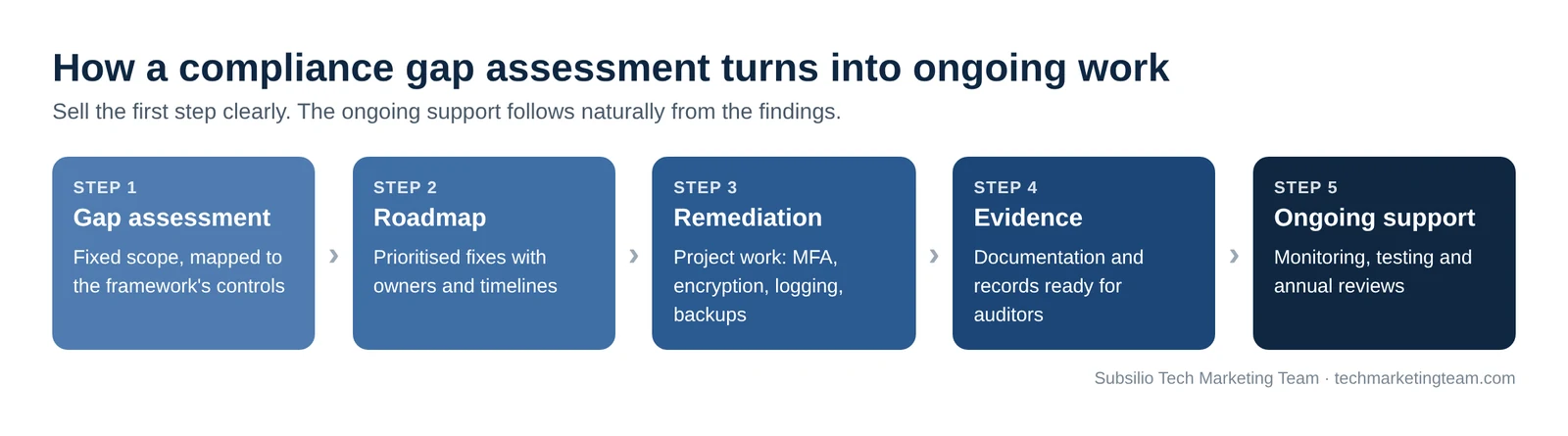
The assessment sells the roadmap; the roadmap sells the ongoing support.
Describe the assessment precisely on your website:
- Scope: which framework, which systems, which locations.
- Method: interviews, document review, technical checks.
- Deliverable: a gap report mapped to the framework’s controls, a prioritised roadmap, and a list of evidence the client needs.
- Timeline: for example, “two to four weeks for a practice of up to 50 staff.”
- Price: a fixed fee or a clear range. Paid assessments attract serious buyers and signal real work.
Keep this separate from your general security offers. A general cybersecurity scorecard is a good top-of-funnel lead magnet. A compliance gap assessment is a more serious, framework-specific piece of work for buyers with a requirement to meet.
Build pages by framework and industry
A single “Compliance” page can’t rank for or speak to all of these buyers. Build one page per framework and industry combination:
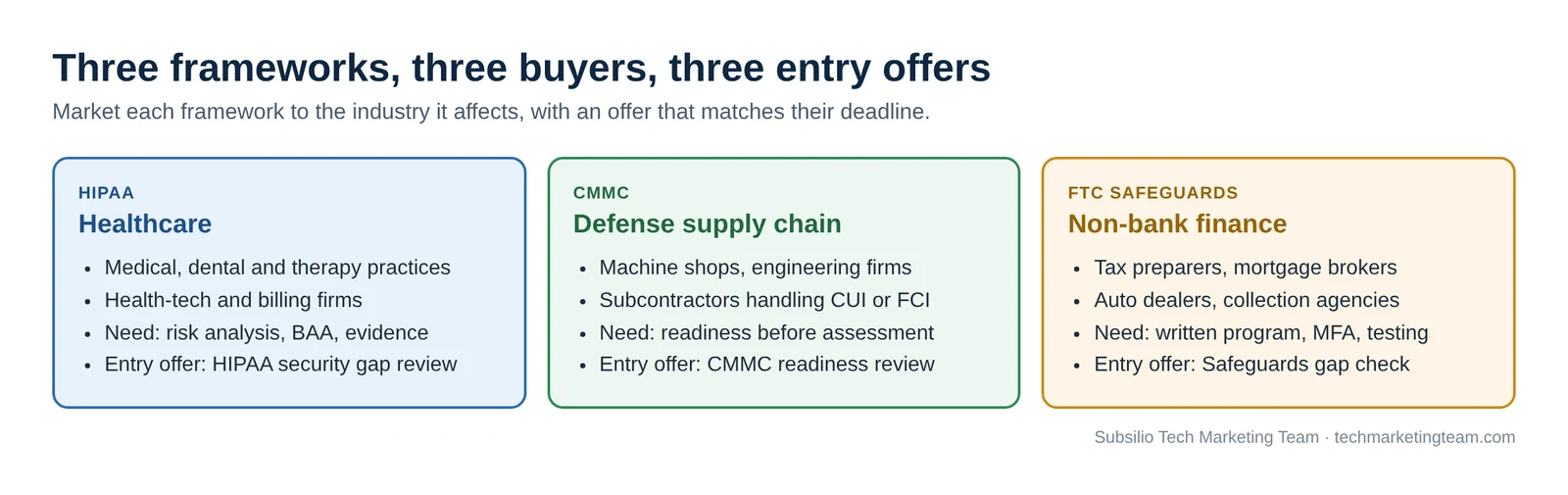
One framework, one buyer, one entry offer per page.
- “IT support for HIPAA-covered practices in Denver”
- “CMMC readiness IT support for defense contractors”
- “FTC Safeguards Rule IT support for tax preparers and mortgage brokers”
Each page should cover: who the rule applies to, the key requirements in plain English, which parts your MSP handles and which stay with the client, your gap assessment offer, relevant case studies, and an FAQ. Put a “last reviewed” date near the top.
This is different from a general cybersecurity service page. For that, see cybersecurity service pages that rank and convert. Use MSP schema markup for your service and FAQ sections, and our MSP SEO services to plan the keyword targets.
Content that builds compliance authority
- Deadline explainers, such as “CMMC Phase 2: what changes for subcontractors.” Update them when rules change, and show the update date.
- Plain-English control guides. For example, “What the FTC Safeguards Rule means by a Qualified Individual.”
- Shared-responsibility explainers. What the MSP does, what the client must do, and what a third-party assessor does.
- Checklists that a practice manager or office manager can actually use.
- Webinars with partners, such as a healthcare attorney or a CPA, who bring credibility and their own audience.
- Industry case studies showing how a client moved from gaps to evidence. See industry-specific case studies for MSPs.
Clear, specific, current answers are exactly what AI search tools pull into their responses. Write each FAQ answer first and keep it factual. See answer-first FAQ content for MSPs.
Where to reach regulated buyers
- Search. Regulated buyers search for the rule by name, often close to a deadline. Make sure your framework pages rank for those terms. A small Google Ads budget on framework keywords can capture urgent searches.
- LinkedIn. Target by industry and role: practice managers, compliance officers, controllers and owners. Share explainers, not pitches. See our social media services.
- Industry associations. State medical and dental societies, local accounting and mortgage groups, and defense industry associations often welcome educational speakers.
- [Referral partners](https://techmarketingteam.com/msp-referral-partner-marketing/). CPAs, attorneys, cyber insurance brokers and compliance consultants already advise these buyers.
How to measure compliance marketing
- Organic traffic and leads to each framework page
- Gap assessments requested, by framework
- Assessment-to-ongoing-support conversion rate
- Average contract value for compliance clients compared with other clients
- Visibility in AI answers for framework questions in your area (see our guide to measuring MSP SEO and AI visibility)
Common mistakes to avoid
- One generic “Compliance” page for every framework and industry
- Outdated deadlines or describing proposed rules as final
- Claiming certifications that don’t exist or that you don’t hold
- Fear-heavy headlines about fines instead of clear, helpful guidance
- Hiding what the client is still responsible for
- Never updating pages after the rules change
Final thoughts
Compliance-led marketing works because it meets regulated buyers where they already are: facing a requirement, a deadline and a question they need answered. Pick one framework and one industry you serve well, explain the rules accurately, lead with a clear gap assessment, and be honest about what you do and don’t do. That earns more trust than any promise of being “fully compliant.”
Subsilio Tech Marketing Team builds framework-specific service pages, content and campaigns for MSPs and IT companies. Book a free strategy call and we’ll show you where your compliance offers could rank and convert.
This article is general information about marketing compliance services. It is not legal advice.
Frequently Asked Questions
Is there such a thing as HIPAA certification for an MSP?
No. HHS does not certify organisations as HIPAA compliant. An MSP can support a client’s HIPAA security program, sign a business associate agreement, and provide evidence of the controls it manages, but it should not claim to be “HIPAA certified.”
Does an MSP need a business associate agreement with healthcare clients?
Generally yes, if the MSP creates, receives, maintains or transmits electronic protected health information on the client’s behalf. Healthcare clients will usually ask for one before signing.
When does CMMC Level 2 third-party certification start?
Phase 2 of the CMMC rollout began on November 10, 2026. From that date, applicable DoD contracts can require Level 2 certification by an authorised third-party assessor.
Which businesses does the FTC Safeguards Rule apply to?
It applies to many non-bank financial businesses, including tax preparers, mortgage brokers, auto dealers, collection agencies, finance companies and some financial advisers.
What is a compliance gap assessment?
It is a structured review of a business’s current security controls against a specific framework, such as HIPAA, CMMC or the FTC Safeguards Rule. It produces a list of gaps, a prioritised roadmap and the evidence the business still needs.
Should an MSP charge for a compliance gap assessment?
Usually yes. Compliance assessments take real engineering time, and a fixed fee sets clear expectations and attracts buyers who are serious about the work.
How should an MSP market compliance without using fear?
Focus on clarity: explain who the rule applies to, what it requires, what the deadline is and what the first step looks like. Accurate, helpful content builds more trust than warnings about fines.