



Open ten MSP cybersecurity pages in ten browser tabs and you will struggle to tell them apart.
They open with a statistic about how often small businesses are attacked. They list the same eight services: endpoint detection, email security, MFA, backup, security awareness training, vulnerability scanning, SIEM, incident response. They mention two or three framework acronyms. They close with a button that says “Get a Free Security Assessment.” Swap the logos and nobody would notice.
This is not a copywriting problem. It is a positioning failure that shows up as a copywriting problem, and it has two measurable consequences: the pages do not rank, because there is nothing on them Google could not find on two hundred near-identical pages, and they do not convert, because the buyer cannot work out what makes this provider different from the last two they spoke to.
This guide covers what to do instead: how to map cybersecurity search intent properly, how to structure the page, what proof actually moves a buyer, how to handle compliance-driven variants without creating thin duplicate pages, and how to mark it all up so both traditional search and AI answer engines can use it.
Why cybersecurity is the hardest MSP page to get right
Three forces make this page harder than your managed IT or cloud pages.
The buyer is frightened and sceptical at the same time. They have been marketed to with fear for years. Another breach statistic in your opening paragraph does not create urgency, it triggers the pattern-match that says this is a sales page. Meanwhile the actual anxiety is real: they genuinely do not know whether they are protected, and they cannot evaluate your answer.
The buyer often cannot assess your competence. An office manager evaluating three MSPs has no way to judge whether your EDR stack is better than anyone else’s. So they fall back on proxies: how clearly you explain things, whether your claims are specific, whether other people like them trust you, and whether you sound like you are hiding something behind jargon.
Search intent is unusually fragmented. “Cybersecurity services” is one query. “Do we need a SOC or is EDR enough,” “cyber insurance requires MFA what do we do,” “CMMC Level 2 for a 30-person shop,” and “we think we’ve been breached” are entirely different queries with entirely different urgency, and they should not all land on the same page.
The diagnostic question we ask MSPs: if a prospect read only your cybersecurity page and nothing else, could they explain to a colleague what you specifically do, who you specifically do it for, and what it would cost them roughly? If not, the page is decorated.
Step 1: Map intent before you write a word
Cybersecurity search demand for an MSP splits into four distinct intent bands. Each needs its own destination, and collapsing them into one page is the single most common structural mistake we see.
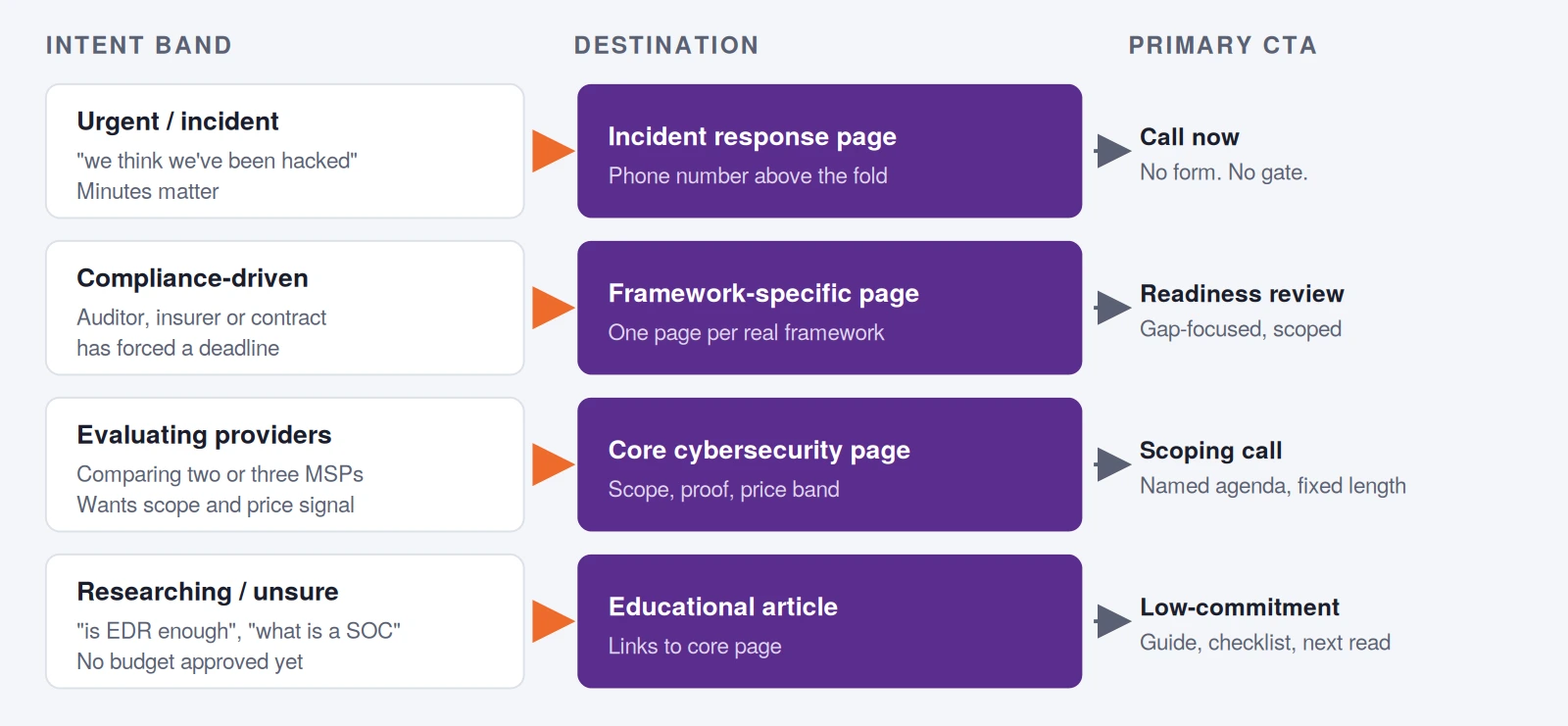
The incident response page deserves particular emphasis, because almost no MSP has one and the intent is the highest-value traffic in the category. Someone searching “ransomware help near me” at 11pm is not filling in a form. Put a phone number, a plain statement of what happens when they call, and your response hours above the fold. Nothing else.
Step 2: Structure the core cybersecurity page
Section order matters more than section content, because most visitors scroll rather than read. This is the sequence that consistently performs.
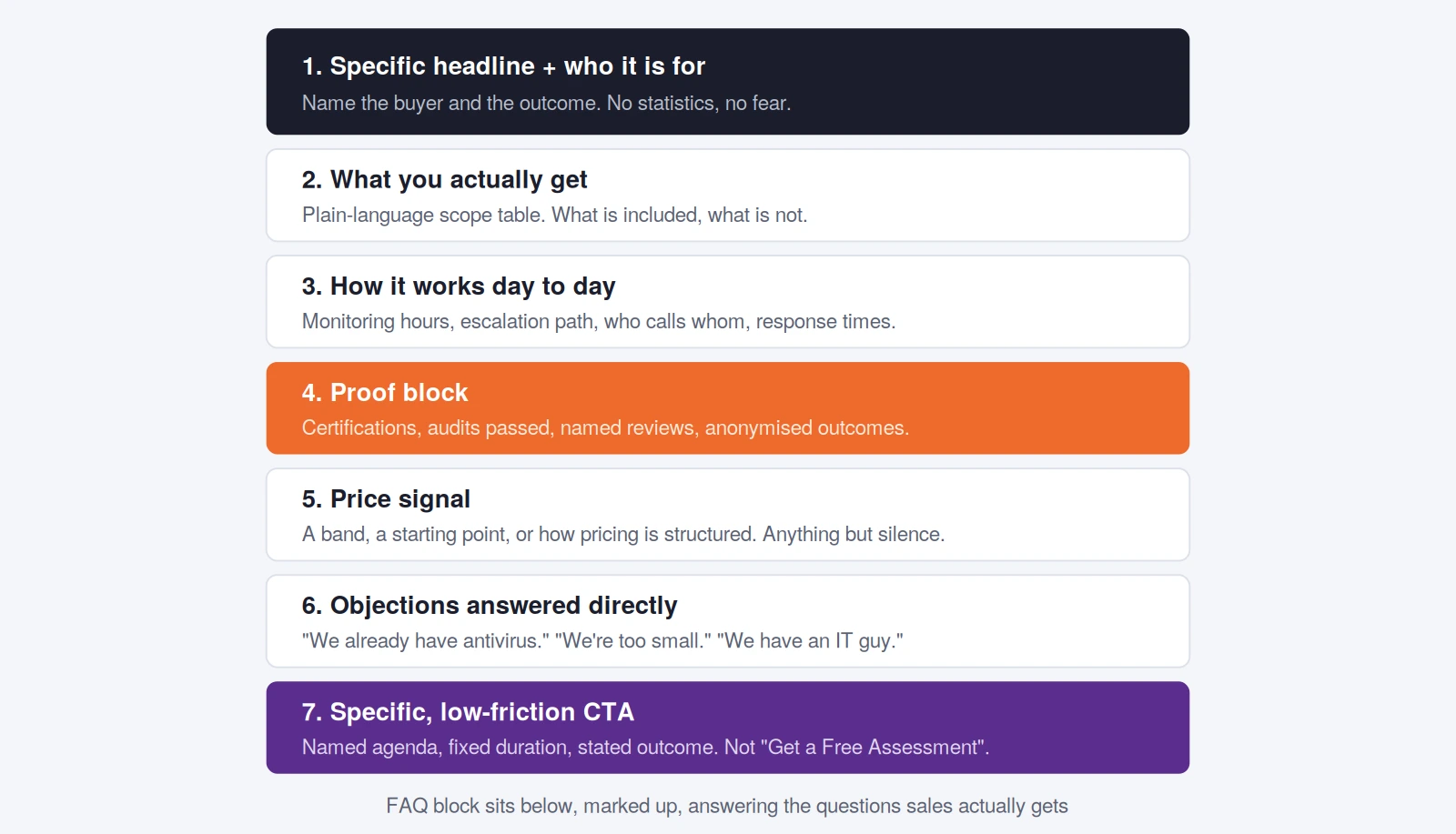
The scope table is the highest-leverage element on the page
Most MSP cybersecurity pages list services as bullet points with no boundaries. Replace that with a table that states, in plain terms, what is included and what is explicitly not. Something like:
| Area | What is included | What is not |
|---|---|---|
| Endpoint protection | Managed detection on every workstation and server, 24/7 alerting, remediation of confirmed threats | Personal devices not enrolled in management |
| Email security | Filtering, impersonation protection, quarantine review, user release requests | Rebuilding a compromised mailbox after a breach (billed separately) |
| User training | Monthly simulated phishing, quarterly training modules, reporting to leadership | In-person training sessions |
| Response | Containment within stated response window, root cause, written incident report | Legal, PR or regulatory notification support |
Two things happen when you publish this. Buyers trust you more, because nobody who is hiding something publishes their exclusions. And your close rate on the deals you do win improves, because you have pre-qualified out the people who wanted something you do not sell. Exclusion is a conversion asset, not a risk.
Say something about price
The most common objection we hear from MSPs is that pricing varies too much to publish. It does vary, and you can still give a signal. “Most clients between 20 and 80 users invest between X and Y per user per month, depending on compliance requirements” removes the single biggest reason a qualified buyer bounces, and simultaneously deters the unqualified ones who were never going to buy. Silence on price does not protect margin. It just moves the disqualification to a call you had to attend.
Answer objections on the page, not on the call
Ask your sales team for the five things prospects say right before they hesitate. They will be some version of: we already have antivirus, we’re too small to be a target, we have an internal IT person, our data is in the cloud so it’s protected, and we did a security review two years ago. Each one deserves a short, honest, non-defensive answer on the page. This section routinely outperforms every other block on time-on-page, because it is the only part written about the reader’s actual thought process.
Step 3: Handle compliance variants without creating thin pages
Compliance-driven searches (CMMC, HIPAA, PCI DSS, SOC 2, cyber insurance questionnaires, state privacy laws) carry the highest commercial intent in the category, because a third party has already created the deadline and the budget.
The temptation is to spin up a page for every framework and every city combination. Don’t. That is precisely the pattern Google’s spam policies describe as scaled content abuse, and it is also commercially useless, because a page written by someone who has never delivered against that framework reads exactly like a page written by someone who has never delivered against that framework.
Build a framework page only where all three of these are true:
- You have actually delivered against it, more than once
- Someone on your team can name the specific control areas where SMBs typically fail
- You can describe your delivery process for it, not just define the acronym
A genuine framework page should contain the assessment timeline, the controls that typically require the most remediation work in businesses of that size, what the client’s own team has to do versus what you do, realistic cost drivers, and what happens if they fail. That page will rank against generic competitors indefinitely, because it contains information that can only come from having done the work. It is also exactly the kind of content that surfaces in AI answers, for the same reason.
Two or three real framework pages beat twelve shallow ones, every time.
Step 4: Proof that actually shifts a sceptical buyer
Cybersecurity is the closest an MSP gets to a trust-critical purchase. The proof block therefore carries disproportionate weight, and most MSPs fill it with the weakest available evidence: vendor partner badges.
Partner logos prove you have a reseller agreement. Buyers increasingly know this. Rank your proof in this order:
- Third-party audit or certification you personally hold: SOC 2 as an organisation, CMMC status, ISO certification. This is verifiable and rare among smaller MSPs.
- Named client reviews that mention security specifically. A generic five-star review is worth far less than one that says “they found a gap in our access controls our previous provider missed.” Ask for specificity when you request reviews.
- Named individuals with credentials. Who leads security in your firm, what certifications do they hold, how long have they done this. Anonymous expertise is not expertise as far as a buyer or a search engine is concerned.
- Anonymised outcome data. Phishing failure rates before and after training across your client base. Mean time to containment. Audits passed. Aggregate, honest numbers with a stated methodology.
- Vendor badges. Last, small, and not in the hero.
Reviews deserve their own note. For a security service, review recency matters more than volume, a buyer weighs eight reviews from the last twelve months above forty from four years ago. Our piece on how five-star reviews help MSPs weather a recession covers the operational side of keeping that flow steady.
Step 5: Technical execution for search and AI visibility
Once the page is right for humans, a handful of technical decisions determine whether it can be found and cited.
One page per intent, properly canonicalised
Cannibalisation is rampant on MSP sites: a cybersecurity service page, a managed security page, a “cyber protection” page and three location variants all chasing the same query. Pick one canonical page per intent, consolidate the rest with redirects, and link the survivors deliberately. Our guide to MSP website architecture works through this consolidation in detail.
Structured data
Mark up the page with Service nested under your Organization, and add FAQPage markup to the FAQ block. Be aware that FAQ rich results are now shown only for a narrow set of authoritative government and health sites, so do not add the markup expecting a visual result, add it because it gives machines an unambiguous question-and-answer structure to parse. Structured data is not required for generative AI features, as Google states directly in its generative AI optimisation guide, but it remains worthwhile for rich result eligibility and clarity. Our MSP schema markup guide covers the full implementation.
Make sure AI crawlers can actually reach the page
This one is worth checking today. Aggressive web application firewall rules are one of the most common reasons an MSP’s security pages are invisible in AI answers, the firewall blocks the very crawlers that would cite you. Because MSPs tend to run tighter security on their own sites than most businesses, they are disproportionately affected. Review your WAF and bot rules, and confirm your site is included in Search generative AI features in Search Console rather than opted out.
Speed and clarity of the main content
A page must be indexed and eligible to be shown with a snippet before it can appear in generative AI features at all. That means the fundamentals still gate everything: crawlable, fast, mobile-legible, with the main content clearly distinguishable from navigation and promotional furniture. If your cybersecurity page loads a video hero and three tracking scripts before any text appears, fix that before you touch the copy.
Step 6: The CTA, replace “free assessment” with something real
“Get a Free Security Assessment” is the default CTA across the entire MSP industry, which means it carries no information and no differentiation. Worse, buyers have learned it means a sales call.
Specify it instead. State the duration, the agenda, who attends, what they receive, and what happens next. “A 30-minute review of your current controls against the five gaps we most often find in firms your size. You get a one-page written summary whether or not you work with us.” That converts better because it is a described transaction, not an implied one.
And offer a second, lower-commitment path for the majority who are not ready: a guide, a checklist, a next article. Our conversion-focused website service is built around exactly this kind of dual-path design, because forcing every visitor toward a call loses the 90 percent who were never going to book one on the first visit.
Putting it together
A cybersecurity page that ranks and converts is not a longer version of the page you have. It is a narrower one, aimed at a specific buyer, with boundaries stated, proof stacked in order of credibility, price signalled, objections met head-on, and a CTA that describes an actual event.
The reason so few MSPs have one is that every element on that list requires a decision, about who you serve, what you refuse to do, and what you charge. Those decisions are uncomfortable and they are also the entire source of the page’s advantage. The generic page is generic because it avoided them.
Get your cybersecurity pages audited
We build service pages for IT providers and MSPs that rank in search and convert the traffic they earn, with the intent mapping, proof structure and technical execution described here.
Book a free strategy call, or explore our MSP SEO and high-converting website services.
How long should an MSP cybersecurity service page be?
Long enough to cover scope, delivery, proof, price signal, objections and next step, typically 1,200 to 2,000 words for a core page, and longer for framework-specific pages that need to cover assessment timelines and control detail. There is no ideal page length, and Google says so explicitly. Length should be determined by how much the buyer needs to make a decision, not by a word count target. A 900-word page that answers the real questions outperforms a 3,000-word page padded with definitions.
Should MSPs create separate pages for each compliance framework?
Only for frameworks you have genuinely delivered against more than once. A real framework page contains assessment timelines, the control areas where businesses of that size typically fail, the split of work between you and the client, and realistic cost drivers, information that only comes from having done it. Spinning up shallow pages for every framework risks falling under Google’s scaled content abuse policy and rarely converts, because the thinness is obvious to a buyer who is already under audit pressure.
Should we publish cybersecurity pricing on our website?
Publish a signal, even if you cannot publish a fixed price. A per-user range tied to organisation size and compliance requirements removes the biggest reason a qualified buyer leaves without contacting you, and filters out prospects who were never in your range. Complete silence on price does not protect your margin; it moves the disqualification conversation to a sales call you then have to attend.
Do I need a separate incident response page?
Yes, if you offer incident response. Someone searching during an active incident has completely different needs from someone researching providers: they need a phone number, your response hours, and a plain statement of what happens when they call. This is high-intent, low-competition traffic that most MSPs never capture because the information is buried inside a general services page behind a contact form.
Does FAQ schema still produce rich results in Google?
For most sites, no. Google narrowed FAQ rich results in 2023 so that they now appear primarily for well-known government and health websites. The markup is still worth adding, because it gives search systems and AI features an unambiguous question-and-answer structure to parse, but you should not implement it expecting a visual change in the search results. Treat it as machine clarity, not as a rich result play.
Why isn't my MSP cybersecurity page showing up in AI search results?
The most common causes are that the page is not indexed or not eligible to be shown with a snippet, that a web application firewall or bot-blocking rule is preventing AI crawlers from reaching it, that the site has been excluded from Search generative AI features in Search Console, or that the content is commodity material available on hundreds of near-identical pages. MSPs are disproportionately affected by the firewall issue because they run tighter security on their own sites than most businesses do.
What is the best call to action for a cybersecurity service page?
A specifically described event rather than a generic offer. State the duration, the agenda, who attends, what the prospect receives, and what happens afterwards. Pair it with a genuinely low-commitment secondary option (a guide or checklist) for visitors who are not ready to talk to anyone. Generic “free assessment” buttons underperform because every competitor uses the same wording and buyers read it as a sales call.