


There’s a reason seminars have been a staple of MSP marketing for years: when a business owner spends an hour with your team in person, trust builds faster than any website or email can manage. A good lunch-and-learn can produce more qualified meetings in one afternoon than a month of online campaigns.
There’s also a reason many MSPs gave up on them: half-empty rooms, attendees who were really just there for the free lunch, and no clear way to turn the event into new clients.
This guide covers what separates a full room from an empty one: the right topic, the right partners, a realistic promotion timeline, an agenda that teaches rather than pitches, and follow-up that turns attendees into consultations.
The short answer
Pick a business-first topic that owners and executives are actually worried about, co-host with a trusted partner such as a chamber of commerce, insurance broker or CPA, and keep the room small. Promote for about six weeks, relying mainly on personal invitations. In the room, teach and take questions rather than pitching. Then follow up within 24 hours with the slides, a useful checklist and an offer of a short one-to-one review.
Why events still work for MSPs
- Trust is built faster in person. Buying managed IT means trusting someone with your systems. Meeting the team helps.
- Local is an advantage. Large national providers can’t easily host a breakfast in your area. You can.
- Busy executives make time for peers. A room of local business leaders is a draw on its own.
- You learn what buyers worry about. Questions from the room make excellent content afterwards.
As AI tools write more of the content people read online, real-world credibility becomes harder to fake, and more valuable.
Choose a topic executives will leave the office for
The topic decides who shows up. Technical titles attract technical people (or nobody). Business-first titles attract owners and decision-makers.
| Weak title | Stronger title |
|---|---|
| “Next-generation endpoint security” | “What your cyber insurer will ask at renewal, and how to answer” |
| “Microsoft 365 best practices” | “Are you paying for Microsoft licences nobody uses?” |
| “AI and the modern workplace” | “Your staff are already using AI tools. What’s safe and what isn’t?” |
| “Cybersecurity awareness” | “How local businesses are losing money to invoice fraud” |
| “Compliance overview” | “FTC Safeguards Rule: what tax and mortgage firms must do now” |
Good topics are specific, tied to money, risk or time, and feel slightly urgent without using fear. Ask your account managers what clients are asking about this quarter. That’s usually your best topic.
Pick the right format
| Format | Best for | Typical size |
|---|---|---|
| Breakfast briefing | Owners who protect their working day | 15 to 30 |
| Lunch-and-learn | Office managers, operations and finance leads | 15 to 40 |
| Executive roundtable | CEOs and senior leaders who want peer discussion | 8 to 12 |
| Co-hosted seminar | Reaching a partner’s audience (chamber, CPA, insurer) | 30 to 80 |
| Webinar plus local follow-up | Wider reach, or testing a new topic | Varies |
For reaching C-level buyers, the executive roundtable is often the most effective. A small group, a strong discussion and no presentation slides make it feel like a peer meeting, not a sales event.
Find partners and venues
- Chambers of commerce. In the Denver area, groups such as the Denver Metro Chamber of Commerce and the Arvada Chamber of Commerce run member events and may co-host or promote educational sessions.
- Industry associations. Legal, dental, accounting and manufacturing groups often welcome expert speakers.
- [Referral partners](https://techmarketingteam.com/msp-referral-partner-marketing/). Insurance brokers, CPA firms and attorneys bring their own audience and credibility.
- Venue. A private room in a restaurant or a business club works better than your own office for a first event. Pick somewhere easy to park and close to where your buyers work, such as downtown Denver, the Denver Tech Center or Arvada.
- Timing. Tuesday to Thursday works best. Avoid month-end, school holidays and major local events.
Fill the room: a six-week plan
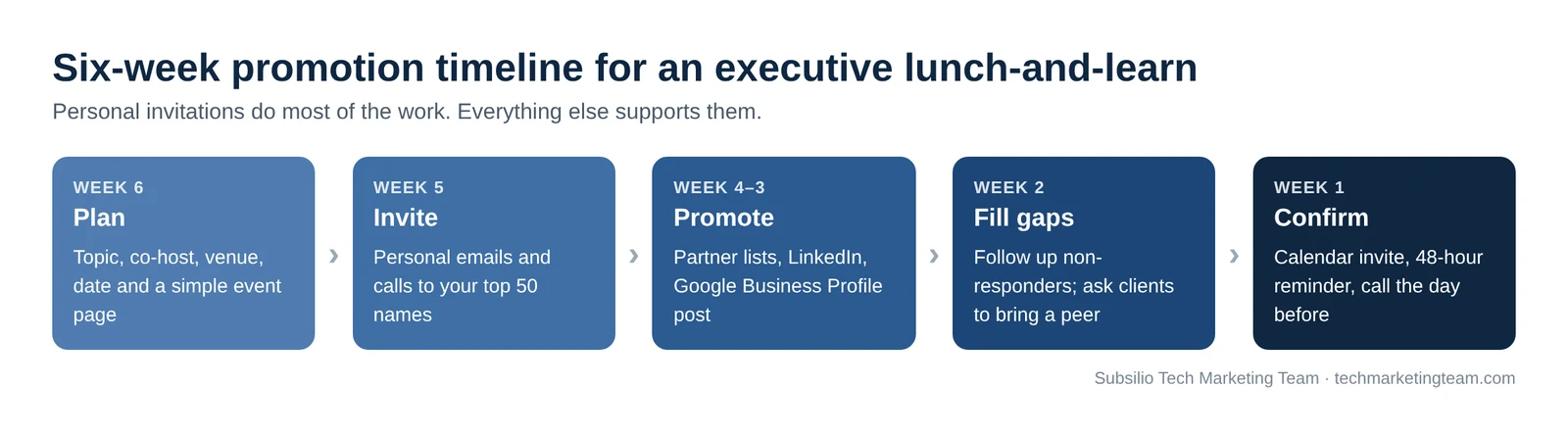
Most registrations come from personal invitations, not ads.
- Build an invite list. Start with your top 50 names: prospects in your pipeline, past proposals, partners’ clients and local business contacts.
- Invite personally. A short email from the owner or account manager, followed by a call, beats any mass email.
- Ask clients to bring a peer. Happy clients are your best promoters, and they often know exactly the right person.
- Create a simple event page on your website. Include the topic, what attendees will learn, speaker, date, venue, parking and a short registration form.
- Mark up the page with Event schema so search engines understand it. See our MSP schema markup guide.
- Post it on your Google Business Profile. Google Business Profile posts include an event type, which shows your event to people who find you on Google.
- Promote on LinkedIn. Create a LinkedIn event and share posts from both your company page and your team’s personal profiles. Our social media services can help.
- Consider a small, local ad campaign. LinkedIn or Google ads targeted by location and job title can fill a few final seats. See our digital ads services.
Reduce no-shows
- Send a calendar invite as soon as someone registers
- Send a reminder 48 hours before, with parking details
- Call registrants the day before. It’s the single biggest no-show reducer.
- Keep the room small enough that empty seats are noticed, and expect some drop-off
Run an event people remember
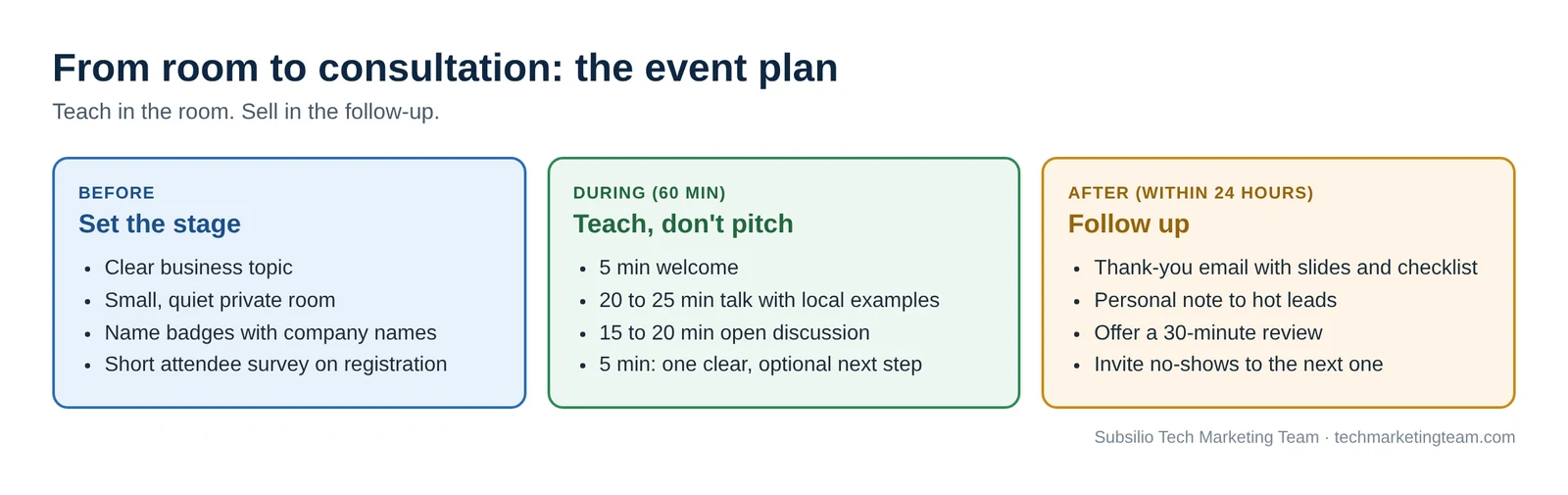
Keep the in-room offer optional and easy to say yes to.
- Teach, don’t pitch. If the content is useful, people will want to know who you are. Keep company slides to one at the end.
- Use local, anonymised examples. “A 30-person firm in Arvada lost a week of billing to ransomware” lands harder than national statistics.
- Leave plenty of time for questions. The discussion is often the most valuable part, for attendees and for you.
- Bring an engineer. Executives trust the person who clearly knows the technical detail.
- Make one clear, optional offer. For example, a 30-minute review of their cyber insurance questionnaire or Microsoft 365 setup.
Follow up within 24 hours
The event creates interest; the follow-up turns it into meetings. Most MSPs lose momentum here.
- Same day or next morning: thank-you email with the slides, a practical checklist and the offer.
- Hot leads (asked questions, mentioned a problem): personal email or call from the speaker within 24 hours.
- Warm attendees: a short, useful follow-up a week later, such as an article answering a question raised in the room.
- No-shows: send the recording or summary and invite them to the next event.
Repurpose every event
One event can feed your marketing for months:
- Turn the talk into a blog post, and the audience questions into an FAQ. See answer-first FAQ content for MSPs.
- Cut short video clips of the speaker for LinkedIn and your website
- Share photos (with permission) on social media and your Google Business Profile
- Turn the checklist into a downloadable resource on your site
- Ask satisfied clients who attended for a Google review. See when to ask for a Google review.
Budget and measurement
Costs usually include venue and food, printing, any promotion, and your team’s time. Measure the event against the business it creates, not the number of lunches served:
| Metric | What it tells you |
|---|---|
| Registrations and attendance rate | Topic appeal and reminder process |
| Share of attendees who are decision-makers | Whether your invite list is right |
| Meetings booked within 30 days | Whether the follow-up works |
| Pipeline and closed revenue within 6 months | Whether the event was worth it |
| Cost per meeting booked | Comparison with other channels |
Common mistakes to avoid
- Technical topics that only attract other IT people
- Relying on mass email instead of personal invitations
- Spending 45 minutes on your company and your tools
- Booking a room that is too big
- Waiting a week to follow up
- Running one event, judging the whole channel on it and stopping
Final thoughts
Executive events still work for MSPs because trust is still personal. Choose a topic owners genuinely care about, partner with groups that already have their attention, invite people one by one, teach rather than sell, and follow up fast. Run them regularly, and the room gets easier to fill each time.
Subsilio Tech Marketing Team helps MSPs promote events with event pages, local ads, LinkedIn campaigns and content that keeps working after the event ends. Book a free strategy call to plan your next one.
Frequently Asked Questions
Do lunch-and-learns still work for MSPs?
Yes, when the topic is business-focused, the room is small and the follow-up is fast. In-person events build trust quickly, which matters when a business is choosing who to trust with its IT.
What topics work best for MSP seminars?
Topics tied to money, risk or time that owners already worry about, such as cyber insurance renewal questions, invoice fraud, unused Microsoft licences, safe use of AI tools, or industry compliance deadlines.
How far in advance should an MSP promote an event?
About six weeks. Use the first weeks for planning and personal invitations, the middle weeks for wider promotion, and the final week for confirmations and reminders.
How do you get executives to attend an IT event?
Invite them personally, choose a business-first topic, co-host with a partner they trust such as a chamber of commerce or CPA firm, keep it short, and make the room small enough to feel exclusive.
How do you reduce no-shows at business events?
Send a calendar invite at registration, a reminder 48 hours before, and call each registrant the day before. Personal calls make the biggest difference.
Should an MSP sell at a lunch-and-learn?
Not directly. Teach in the room and make one optional offer at the end, such as a short one-to-one review. The selling happens in the follow-up.
How do you measure the ROI of an MSP event?
Track meetings booked within 30 days and the pipeline and revenue they create over the following months, then compare cost per meeting with your other marketing channels.