



Most managed service providers believe they have a content problem. They don’t. They have a retrieval problem.
The average MSP closes several hundred tickets a month. It runs quarterly business reviews with dozens of clients. Its vCIOs write technology roadmaps that map risk, budget and timeline for businesses in a specific city, in a specific industry, at a specific stage of growth. That is a volume and quality of first-hand operational insight that no marketing agency, no freelance writer and no language model can manufacture from the outside.
And almost all of it dies inside a PSA ticket, a PowerPoint deck, or a Word document in a client folder.
Meanwhile the MSP’s blog runs “5 Benefits of Managed IT Services”, a post that could have been written about any MSP, anywhere, by anyone, and which Google explicitly describes as commodity content: material based on common knowledge that adds little unique insight for readers.
This article is the workflow for closing that gap. It covers how to mine your ticket queue for search demand, how to convert a QBR deck into a piece of content that ranks, how to handle the confidentiality problem properly, and how to build a repeatable cadence that survives a busy month. We have run this process with MSPs across the US, and the pattern is consistent: the content that performs is almost never the content the marketing team invented. It’s the content the service desk already lived.
Why operational content outranks generic MSP content
Google’s own guidance on generative AI search draws a hard line between two kinds of material. On one side sits commodity content, the “7 tips” article, the definitional explainer, the listicle that restates what is already on a hundred other sites. On the other sits non-commodity content that provides unique expert or experienced takes that go beyond common knowledge.
That distinction matters more than it used to, for three reasons.
First, generative AI features reward source-worthiness, not word count. AI Overviews and AI Mode are grounded in Google’s search index using retrieval-augmented generation. The system pulls pages that contain specific, retrievable, defensible claims. A page that says “downtime is expensive” is not retrievable. A page that says “in 40 dental practice migrations we found the imaging software, not the server, was the constraint 8 times out of 10” is.
Second, query fan-out rewards depth on narrow problems. When someone asks an AI assistant a complex question, the model generates a set of related sub-queries behind the scenes and fetches results for each. A generic overview page satisfies none of those sub-queries well. A page built from a real ticket pattern satisfies several precisely.
Third, experience is the part of E-E-A-T that MSPs can actually prove and competitors cannot copy. Expertise can be claimed. Authority can be built slowly. Experience is either in the content or it isn’t, and your ticket queue is a permanent, renewing supply of it.
The test we apply to every MSP article: could a competitor down the road publish this exact piece with their logo on it and nobody would notice? If yes, it will not earn rankings, citations or leads. Rewrite it from something that only happened to you.
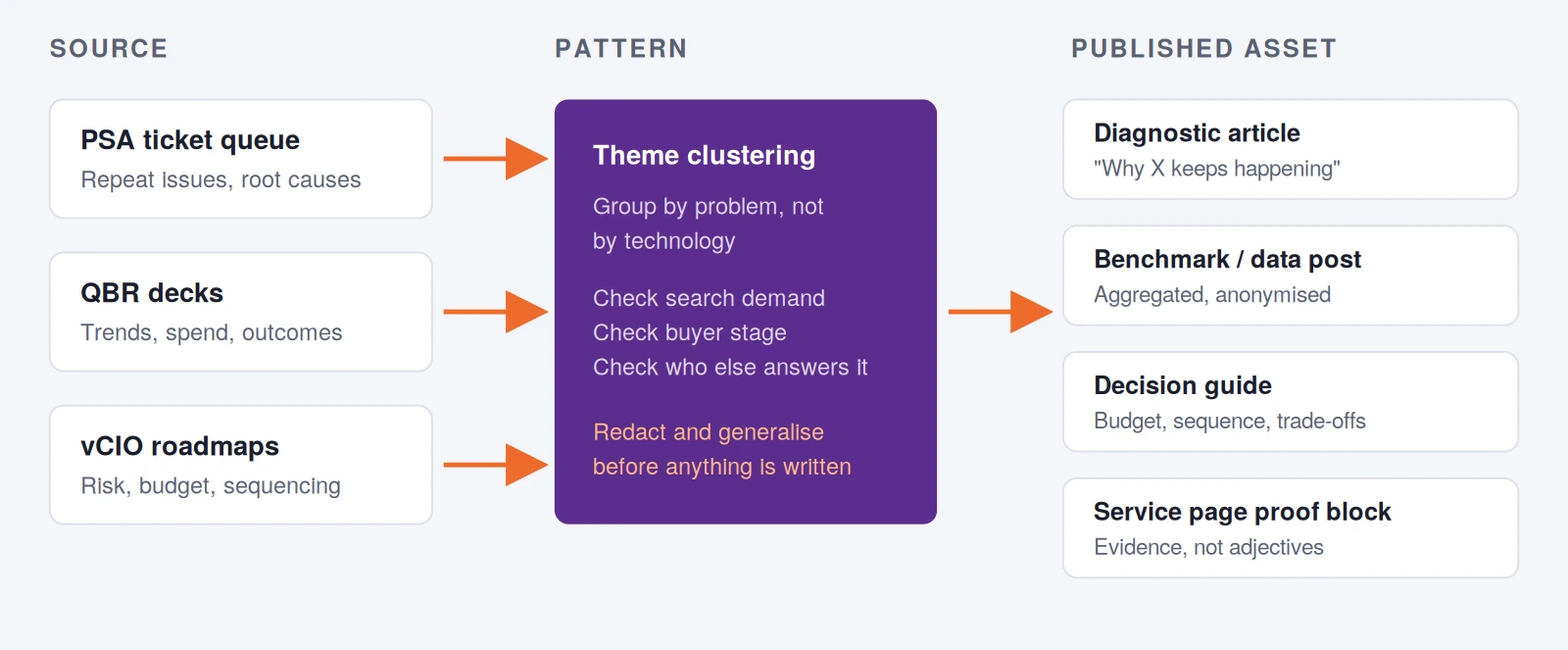
Step 1: Mine the ticket queue for search demand
Start with a simple export from your PSA covering the last 90 days: ticket title, category, resolution summary, client industry, client size band. Strip client names before it leaves the system.
Then look for three signals.
Repeat issues across unrelated clients
If the same problem appears at six clients who share no vendor, no industry and no infrastructure, you have found something structural. That is a content topic. “Why Microsoft 365 mailboxes keep hitting send limits after a merger” is a real search with a real intent behind it. “Cloud email solutions” is not.
Tickets that took an unusual number of touches
High-touch tickets are diagnostic gold. They contain a wrong first hypothesis, a second hypothesis, and a real root cause. That structure maps almost perfectly onto how a technically literate buyer searches: they arrive with the symptom, not the cause. An article organised as symptom → what most people assume → what it usually actually is → how to confirm → how to prevent ranks well and reads as genuinely experienced, because it is.
Tickets that arrived from a prospect, not a client
These are the highest-value of all. A business that calls you before signing anything is telling you exactly which problem is painful enough to make someone pick up a phone. Those problems belong on your service pages, not just your blog.
Validating demand before you commit
Not every ticket theme has search volume, and that’s fine, but you should know which is which before you invest. Group your themes into three buckets:
- Volume topics: measurable monthly searches. These carry your organic traffic.
- Low-volume, high-intent topics: perhaps 10 to 40 searches a month, but every searcher is a qualified buyer. These carry your pipeline.
- Zero-volume authority topics: no meaningful search demand, but they demonstrate depth, get cited, and increasingly surface inside AI answers where the user’s phrasing never matched a keyword tool in the first place.
MSPs consistently under-invest in the second and third buckets because traditional keyword tools make them look worthless. They are not. A page targeting “how to budget for a CMMC Level 2 assessment” may see 20 searches a month and close a six-figure contract. Our MSP SEO service is built around exactly this kind of intent-weighted prioritisation rather than raw volume.
Step 2: Convert QBR decks into comparison and benchmark content
A quarterly business review is a piece of analysis you have already paid to produce. It typically contains ticket volume trends, spend against plan, risk register movement, project outcomes, and a forward roadmap. Almost every one of those sections has a public-facing equivalent.
| QBR section | Public content it becomes | Buyer stage it serves |
|---|---|---|
| Ticket volume by category | “What a normal support load looks like for a 60-person firm” | Problem-aware |
| Risk register movement | “The five risks that actually moved for SMBs this year” | Solution-aware |
| Spend vs plan | “What SMBs really spend on managed IT, and where it goes” | Vendor-aware |
| Project retrospective | Anonymised case study with a stated constraint and trade-off | Decision |
| Forward roadmap | “Sequencing a three-year IT plan without wasting the first year” | Problem-aware |
The benchmark post deserves special attention. Aggregate the same metric across 20 or more clients, anonymise completely, and publish the range. Nobody else in your market has that data. Benchmark content earns links from people who need a number to cite, and it is exactly the kind of specific, attributable claim that AI systems surface. Pair it with an honest methodology note (sample size, date range, client size band) and you have a page that is both linkable and defensible.
Step 3: Turn vCIO notes into decision content
vCIO documentation is the most commercially valuable and most under-used asset in the building, because it is written for the exact moment a buyer is deciding.
A technology roadmap answers questions like: what do we do first, what can wait, what does this cost over three years, what happens if we defer it, and how do we justify it internally. Those are the questions a prospect is asking themselves the week before they call you. Content that answers them well does not just rank: it shortens the sales cycle, because the prospect arrives having already done the thinking you would otherwise have to walk them through.
Three formats work particularly well:
- The sequencing guide. Not “here are ten things to do” but “here is the order, and here is why doing number four first wastes money.” Order is expertise. Lists are not.
- The internal business case. Give the reader the language to sell the project to their own CFO. Include the objections they will face. This is the single most shared type of content MSPs produce, because the reader forwards it internally.
- The deferral cost article. What actually happens if you wait 18 months. Be specific about the mechanism, not the fear. This is where MSPs most often slip into scare-marketing; resist it, because a buyer who feels manipulated leaves.
If you want the wider strategic frame for this, our piece on how strategic planning is revolutionising MSP success covers how roadmap thinking changes the client relationship itself.
Step 4: The confidentiality layer (do this before you write, not after)
This is the part that stops most MSPs, and the objection is legitimate. You are handling client infrastructure detail under an MSA and often an NDA. Publishing carelessly is a genuine commercial and security risk, not a theoretical one.
The solution is a fixed redaction standard applied at the theme stage, before a writer ever sees the material.
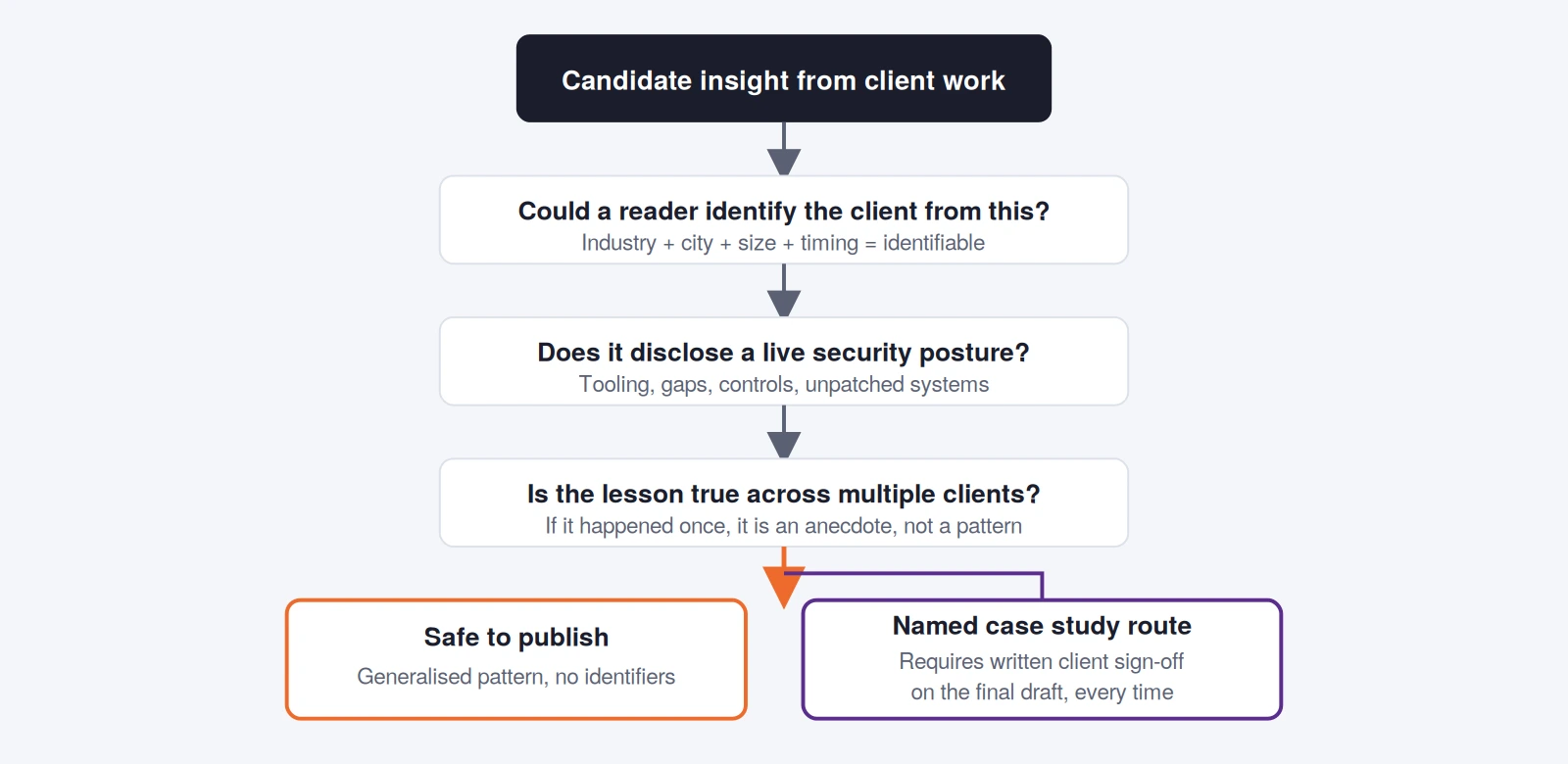
Some practical rules that hold up well:
- Never publish a live security gap, even anonymised, even historically, if the client could plausibly still be exposed. This is non-negotiable.
- Aggregate before you specify. “Across 30 manufacturing clients” is safe. “A 45-person manufacturer in Aurora” is not.
- Shift the timeframe. Never publish about work that is currently in flight.
- Get sign-off in writing on the final draft, not on the concept, whenever a client is named or recognisable.
- Add a standing clause to your MSA permitting anonymised, aggregated use of operational data for educational content. Most clients agree without hesitation when asked at onboarding, and almost none want to revisit it mid-relationship.
Step 5: Build the cadence so it survives a busy quarter
Every MSP content programme dies the same way: a good month, a great month, then an outage, a big project, and six months of silence. The fix is structural, not motivational.
Separate extraction from writing. Your engineers should never be asked to write. Ask them for 15 minutes of talking. A monthly recorded call where a senior tech walks through the three most interesting tickets of the month produces more usable raw material than a year of asking people to “contribute to the blog.”
Bank raw material ahead of publishing. Aim to hold three months of extracted, redacted themes at all times. Publishing cadence then becomes a writing problem, not a sourcing problem, and writing can be outsourced.
Assign one owner with authority to ship. Content programmes stall at approval, not creation. One named person should be able to publish anything that has cleared the redaction filter.
Fix the cadence at a level you can hold in your worst month. Two genuinely original articles a month beats eight in January and zero from March. Search rewards sustained publishing far more than bursts, and so does your sales team’s ability to actually use the material.
Step 6: Make the content retrievable, not just publishable
Operational insight only earns visibility if the page around it is built properly. A few things matter disproportionately for this content type:
- Lead with the specific claim. Put the finding in the first 100 words. Do not build to it. Both readers and retrieval systems weight early, direct statements.
- Use headings that match how people phrase the problem, not how you categorise it internally. “Why our backups keep failing overnight” beats “Backup architecture considerations.”
- State your evidence base explicitly. Sample size, timeframe, client type. This is the difference between an assertion and a citable claim.
- Attribute to a named human with a real role and real credentials. Content sourced from your service desk should carry the byline of someone who works on it.
- Mark it up. Article and Organization schema help machines understand who published what and on whose authority. Our guide to MSP schema markup covers the implementation in detail.
- Link it into your service architecture. An orphaned insight post earns nothing. It should point to the relevant service page, and the service page should point back. Our breakdown of MSP website architecture covers how those clusters should be wired.
For the wider picture of what still drives rankings after AI Overviews changed the results page, see MSP SEO in 2026. And if your goal is specifically to be named inside AI assistant answers, how to get your MSP mentioned in ChatGPT and AI search results goes deeper on that mechanism.
What this looks like after six months
MSPs who run this process properly tend to see the same sequence. Months one and two feel slow, because the extraction habit is new and the first few themes are the obvious ones. Month three is where it changes: the engineers start flagging tickets unprompted, because they have seen their own work published and it is oddly satisfying. By month six there is a backlog rather than a shortage, the sales team is sending articles to prospects mid-cycle, and the blog has stopped being a marketing artefact and started being an extension of the service desk.
The rankings follow, but they are not the most interesting outcome. The most interesting outcome is that the content becomes impossible for a competitor to replicate, because replicating it would require running your business.
Want this running without adding it to your team’s plate?
We build and operate content pipelines for IT service providers and MSPs: extraction, redaction, writing, publishing and measurement. If your ticket queue is full of material nobody has time to use, that is exactly the problem we solve.
Book a free strategy call or see how our MSP SEO programme works.
Is it legal to write blog content based on client support tickets?
Generally yes, provided the content is anonymised and does not disclose confidential information, security posture or anything identifying. The constraint is contractual rather than statutory: your MSA and any NDA govern what you may disclose. The safe standard is to publish aggregated patterns rather than individual incidents, remove all identifying combinations of industry, location, size and timing, and obtain written client approval on the final draft any time a client is named or recognisable. Adding a clause at onboarding that permits anonymised, aggregated educational use removes the friction permanently.
How do I get busy engineers to contribute content without it becoming a chore?
Do not ask them to write. Ask them to talk. A 15-minute recorded monthly call in which a senior technician walks through the three most interesting tickets of the month generates more usable material than months of asking people to submit drafts. Transcribe the call, cluster the themes, and hand the raw material to a writer. The engineer’s contribution should end at the point where they stop talking.
What kind of MSP blog content actually generates leads rather than just traffic?
Content built around a decision a buyer is actively making. Sequencing guides, budget and business-case content, deferral-cost analysis, and honest comparisons of approaches consistently outperform awareness content on lead quality, even when they attract far less traffic. A page with 20 monthly searches that answers “how should we budget for this” can close larger deals than a page with 2,000 searches answering “what is managed IT.”
Should MSP content be written by the technical team or by a marketing agency?
Split the roles. The technical team supplies the substance: the pattern, the root cause, the evidence, the correction of anything inaccurate. The marketing team or agency supplies structure, search alignment, editing and publishing. MSPs that ask engineers to write end up with unpublished drafts. MSPs that let marketers invent the substance end up with commodity content. The pipeline works when each side does only what it is good at.
How often should an MSP publish to see SEO results?
Consistency matters more than frequency. Two genuinely original, operationally sourced articles per month, sustained for twelve months, will outperform a burst of eight followed by a long gap. Set the cadence at a level you can maintain in your busiest month, then hold it. Meaningful organic movement on competitive MSP terms typically takes six to twelve months, with earlier wins on lower-competition, high-intent topics.
Does content sourced from real client work help with AI search visibility?
It helps considerably, because AI features in Google Search are grounded in the search index and favour content that offers specific, verifiable, non-commodity insight. Google’s own optimisation guidance states plainly that unique, experienced content influences visibility in generative AI search more than any technical tactic, and that there is no special file, markup or formatting trick that substitutes for it. First-hand operational content is one of the few genuine advantages an MSP has here.
Can I turn a QBR deck into a case study?
Yes, and it is one of the fastest routes to a strong case study, because the analysis already exists. The two changes required are removing all client identifiers unless you have written permission to name them, and adding the thing QBRs usually omit: the constraint you worked within and the trade-off you made. Case studies that admit a limitation are markedly more persuasive than ones that read as unbroken success.