


Ask within 24 hours of the ticket being closed, while the person still remembers what you fixed. Beyond about 72 hours the response rate falls sharply, and beyond a week most requests are ignored entirely. The exception is a major project or incident, where a short pause of two to three days lets the outcome settle before you ask.
That is the answer. The rest of this article covers the harder part: which tickets to ask on, who to ask, how often, and how to build the request into your service workflow so it happens without anyone remembering to do it.
Most MSPs get the timing wrong in the same direction. They batch review requests into a quarterly newsletter, send them to the whole client list, and get a response rate close to zero. Then they conclude that their clients simply do not leave reviews. Their clients do leave reviews , for the plumber who came out on a Sunday, on the same day, when someone asked them properly.
Why ticket close is the highest-yield moment
Three things are true at the moment a ticket is resolved, and all three decay fast.
DEV NOTE , IMAGE 1 , file: blog-03-01-review-request-timing-window.png , place immediately below this heading, full content width, lightbox link to the full-size file. Sits under the intro line, above the three bolded points.
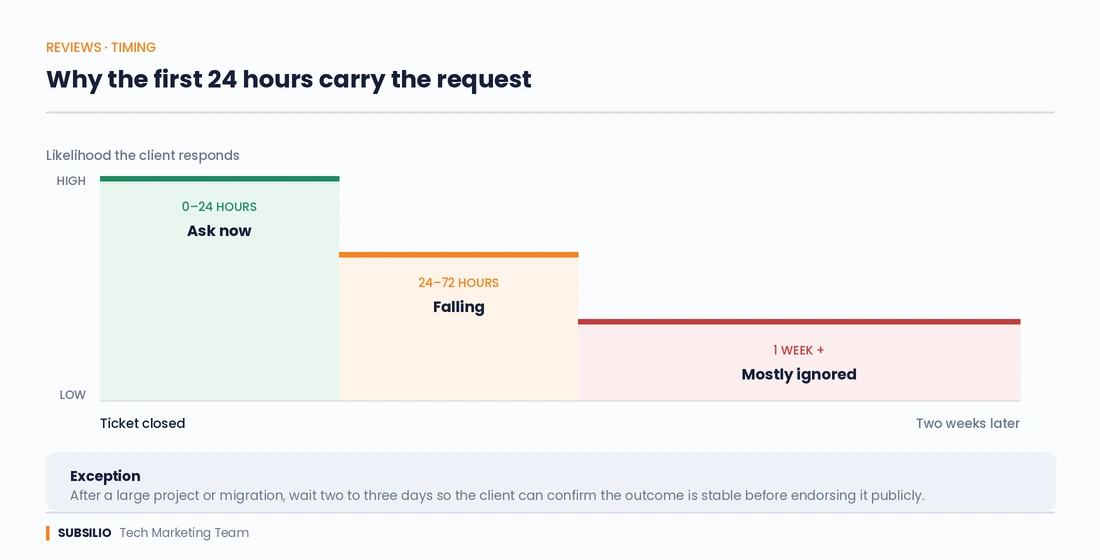
Chart showing how the likelihood of a client leaving a Google review falls sharply after the first 24 hours following ticket resolution.
The person has a specific memory. They can describe what broke, who fixed it and how long it took. Specific reviews are more persuasive to other buyers and more useful to search engines than “great service, highly recommend”. Ask three weeks later and you get the generic version, because that is all they can still recall.
They feel relief. Something was broken, it interrupted their day, and now it is not broken. That is the emotional peak of the entire relationship, and it will not be higher at any scheduled touchpoint.
The interaction is complete. Nothing is pending, nothing is ambiguous. There is no lingering “well, let’s see if it holds” that makes someone hesitate to publicly endorse you.
By day seven the fix is normal, the relief is gone, and your request is an unwelcome task from a vendor.
Which tickets to ask on
This is where most review programmes go wrong, because they either ask on everything or leave it entirely to technician discretion. Neither works. Use explicit criteria.
| Ask | Do not ask |
|---|---|
| Resolved on first contact, with visible effort | The ticket was raised because of something you did or missed |
| A recurring problem finally fixed properly | The resolution took multiple escalations or missed your response commitment |
| Something outside strict scope that you handled anyway | The client had to chase for an update |
| Resolved outside business hours when it mattered | The user has an open ticket elsewhere in the queue |
| Successful onboarding of a new user or site | The fix is provisional, or a workaround rather than a resolution |
| A security incident contained without disruption | The same contact was asked in the last six months |
| A project or migration delivered on schedule | The client is in a billing dispute or contract renegotiation |
| The user thanked the technician unprompted | Anything where you already know the answer is lukewarm |
That last row on the left is the strongest signal available to you. When a user writes “thank you so much, you saved my morning” in a ticket reply, they have already written the review. All that remains is asking them to put it where other people can see it.
Who to ask
An MSP-specific complication that general review advice misses entirely.
The person whose laptop you fixed is usually not the person who signed the contract. The end user had the experience. The decision-maker has the authority. Both can leave a review and they write very different ones.
- End users write better reviews. Specific, warm, concrete. “Marcus had my email working again in under twenty minutes on a Monday morning” is exactly what a prospect wants to read. Ask these people, and ask them often across the client base.
- Decision-makers write more persuasive reviews. They can speak about value, responsiveness across the relationship and business outcomes. Ask them less frequently, and at contract or QBR milestones rather than after individual tickets.
- Check your client’s policy first. Some organisations, particularly in regulated sectors and government, restrict what staff can publicly say about vendors. Being asked to breach an internal policy damages a relationship quickly. Establish this during onboarding, once, and note it on the account.
How often is too often
Review velocity , a steady stream of reviews arriving over time , is more valuable than a burst. A profile that gains thirty reviews in one week and nothing for a year looks manufactured to both readers and platforms.
Reasonable operating limits:
- Never ask the same individual more than twice a year, and preferably once.
- Cap requests per client organisation at two or three per year across all contacts, unless they are a very large account.
- Aim for a consistent monthly cadence rather than campaigns. For a typical MSP, two to four new Google reviews a month is a healthy rate that compounds.
- Track who has been asked and when, at the contact level. Without this, your largest and most engaged clients get asked repeatedly while most of your base never gets asked at all.
What to actually say
The request should be short, specific to what just happened, and sent through the channel the person already used to talk to you.
The structure that works:
- Reference the specific issue. “Glad we could get the Outlook sync sorted this morning.”
- Ask directly, once. “If you have a minute, would you mind leaving us a Google review?”
- Give the link. Directly to your review form, not to your homepage or a landing page. Every extra click loses people.
- Say how long it takes. “It takes about thirty seconds.”
- Stop. No paragraph about how much it means to the team, no second ask, no follow-up sequence.
Three rules about the content:
- Do not script the review. Suggesting what to write produces reviews that read as templated and can breach platform policy. Ask, then get out of the way.
- Do not ask for five stars. Ask for a review. The rating is theirs to decide.
- Do not offer anything in return. Not a gift card, not a discount, not entry into a draw. This is covered in the next section and it matters more than most MSPs realise.
On channel: send it however that person already communicates with you. If the ticket ran over email, email. If your service desk sends a resolution notification, place the request inside it. A phone call from an account manager works well for decision-makers and is overkill for a password reset.
The compliance line
Two sets of rules apply, and breaching either is a bigger risk than the reviews are worth.
Platform policy. Google’s prohibited and restricted content policy for reviews rules out incentivised reviews, fake engagement and content posted on behalf of someone else. Profiles that accumulate policy-violating reviews can have them removed in bulk, and repeat issues put the profile itself at risk.
Review gating is not allowed. Gating means surveying customers first and only routing the happy ones to a public review. It is common, it is sold as a feature by various tools, and it breaches Google’s policy. It also produces a review profile that no longer reflects reality, which is the thing that made reviews valuable in the first place.
Regulatory rules. In the US, the FTC’s rule on consumer reviews and testimonials prohibits fake and incentivised reviews and the suppression of negative ones, with civil penalties attached. This applies to you as the business soliciting reviews, not only to the platform. If you are operating in other markets, check the local equivalent, because most developed jurisdictions have introduced something comparable.
The practical position: ask everyone who qualifies, ask them honestly, accept whatever they write, and never pay for a review in any form. It is slower than the alternatives and it is the only version that survives scrutiny.
The second-best moment: the QBR
If the ticket-close request is your volume channel, the quarterly business review is your quality channel.
A QBR is where you present uptime figures, tickets resolved, projects delivered and risks mitigated, to the person who signs the cheque. If that conversation goes well, the review request is natural and the resulting review carries weight, because it is written by a decision-maker reflecting on a quarter rather than a user reflecting on a printer.
Ask at the end of the meeting, in person or on the call, not in the follow-up email. Then send the link afterwards as a reminder of something they already agreed to.
The same QBR material is useful for more than reviews , our guide to turning tickets, QBRs and vCIO notes into SEO content covers how to mine it properly.
When someone says no, or says something negative
Both are useful, and both are handled badly by most MSPs.
A no is information. If a client declines to review you, something is wrong that has not surfaced in a ticket. Ask why, directly and without defensiveness. You will learn more from that conversation than from three five-star reviews.
A negative review is a visible test. Prospects read negative reviews and, more importantly, they read the response. A defensive or legalistic reply does more damage than the original complaint. Respond within 24 hours, acknowledge the specific issue, state what you have changed, and move the conversation offline. Never mention client names or systems in a public reply.
A profile with a small number of negative reviews handled well is more convincing than an unbroken run of five stars, which increasingly reads as filtered. Our article on how five-star reviews help MSPs weather a recession covers why the overall profile matters more than the average score.
Building it into the workflow
A review programme that depends on someone remembering will not survive a busy month. Make it structural.
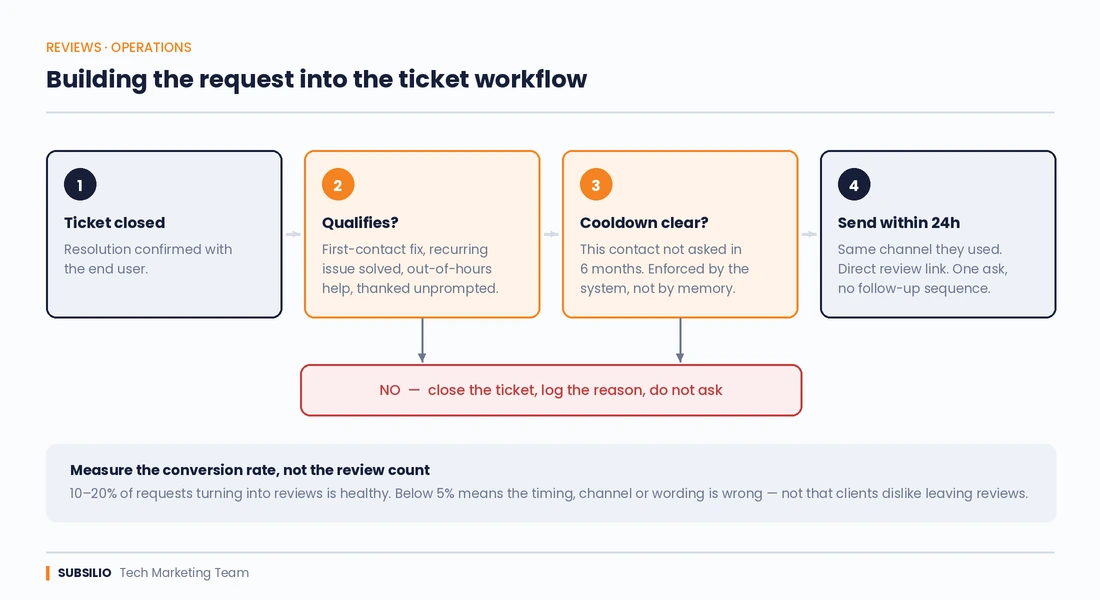
Four-step workflow for triggering an MSP Google review request within 24 hours of a qualifying ticket close.
- Define the qualifying criteria using the table above, and write them down.
- Add a field to the ticket close form: “Review request appropriate? Yes / No / Already asked recently.”
- Set a contact-level cooldown so the same person cannot be asked twice within six months, enforced by the system rather than by memory.
- Trigger the request automatically within 24 hours of a qualifying close.
- Route the link directly to your Google review form, with no intermediate page.
- Assign an owner who reviews the numbers monthly. Without an owner, the programme decays within a quarter.
- Report on request-to-review conversion rate, not just review count. If you are sending 200 requests and getting four reviews, the problem is the request, not the clients.
What good looks like
Benchmarks from MSPs running this properly:
- Request-to-review conversion of 10 to 20 per cent. Below five per cent means the timing, the channel or the wording is wrong.
- Two to four new Google reviews per month, sustained.
- Reviews that name a person and describe a specific problem, rather than generic praise.
- A response on every review, positive or negative, within 48 hours.
- A steady curve rather than spikes.
Where all of this feeds into local search visibility, review volume and recency are meaningful ranking factors in the local pack, and review content containing your service terms and city names supports that further , organically, not because anyone instructed a client to include them. Our guide to why your MSP is invisible on Google and how to fix it covers where reviews sit alongside the other local factors.
The summary
Ask within 24 hours of closing a ticket that went genuinely well, ask the person who experienced it, ask them no more than once or twice a year, and never offer anything in return. Build the trigger into the workflow so it does not rely on anyone’s memory, and give it an owner.
None of this is complicated. It is simply operational, which is why most MSPs talk about it and do not do it, and why the ones who do build a review profile their competitors cannot match.
Want a review programme that runs itself?
We build and manage reputation programmes for IT providers and MSPs, including request workflows, response handling and getting that proof onto your website where it converts.
Explore our reputation marketing service, see what our clients say, or book a free strategy call.
When is the best time to ask a client for a Google review?
Within 24 hours of resolving their issue, while the details are still fresh and the relief is still felt. Response rates drop noticeably after 72 hours and most requests sent a week or more later are ignored. For larger projects or migrations, waiting two to three days after go-live is better, because it allows the client to confirm the outcome is stable before endorsing it publicly.
Should an MSP ask for a review after every ticket?
No. Ask only after tickets that went genuinely well: first-contact resolutions, recurring problems finally fixed, out-of-hours help that mattered, or work handled outside strict scope. Never ask after a ticket caused by your own error, one that required multiple escalations, or where the client had to chase for updates. Asking indiscriminately produces low response rates and occasionally invites the negative review you were not expecting.
How often can an MSP ask the same client for a review?
No more than twice a year per individual contact, and two to three requests per year across a client organisation. Repeated requests irritate clients and produce nothing. Track requests at contact level in your ticketing system with an enforced cooldown, otherwise your most engaged clients get asked repeatedly while most of your base is never asked at all.
Can an MSP offer an incentive for a Google review?
No. Incentivised reviews breach Google’s review policies and, in the US, the FTC’s rule on consumer reviews and testimonials, which carries civil penalties. This covers gift cards, discounts, prize draws and any other form of compensation, whether offered to clients or to your own staff. Reviews obtained this way can be removed in bulk and put the profile itself at risk.
Is it against the rules to only ask happy clients for reviews?
Filtering clients through a satisfaction survey and routing only the positive ones to a public review , known as review gating , breaches Google’s policies, despite being widely sold as a feature. Using judgement about which tickets warrant a request is different and is legitimate. The line is whether you are screening out negative feedback before it can be posted publicly.
Who should an MSP ask for a Google review, the end user or the decision-maker?
Both, at different moments and different frequencies. End users write more specific, more believable reviews and should be asked after individual tickets that went well. Decision-makers write more persuasive reviews about value and the overall relationship, and should be asked at quarterly business reviews or contract milestones rather than after routine support work.
How many Google reviews should an MSP aim for?
A steady two to four new reviews a month matters more than any total. Review recency and a consistent arrival pattern carry more weight in local search than a large number accumulated years ago, and a sudden burst of reviews looks manufactured to readers and platforms alike. Consistency over a year will outperform any one-off campaign.
How should an MSP respond to a negative Google review?
Respond within 24 hours, acknowledge the specific issue without being defensive, state what has changed as a result, and offer to continue the conversation directly. Never name client systems or individuals in a public reply. Prospects read the response more carefully than the complaint, and a well-handled negative review often builds more trust than an uninterrupted run of five-star ratings.