


At some point, every growing MSP hits the same question: “Should we hire someone to do our marketing, or bring in an agency?” Usually the owner has been doing it themselves, badly and in spare moments, and something has to change.
Most comparisons focus on price. Price matters, but it’s rarely what decides whether the choice works out. What decides it is whether the setup gives you the right skills, moves fast enough, and doesn’t collapse when one person leaves.
We’re an agency, so we’ll be upfront about when an in-house hire is the better choice. This guide compares the two options on what actually affects results, and explains when a hybrid makes the most sense.
The short answer
Hire an in-house coordinator when you need someone close to your team every day to gather stories, run events and keep things moving, and you already know your strategy. Choose a specialist MSP agency when you need expert SEO, ads, web and analytics skills quickly, without managing several hires and tools. Many growing MSPs do best with a hybrid: one internal coordinator working alongside a specialist agency.
What MSP marketing actually requires
Modern MSP marketing is not one job. Done properly, it involves technical SEO, local search, content, Google and LinkedIn ads, website conversion work, review generation, analytics, design and sales alignment. A marketing coordinator is usually a generalist: good at organising and producing, but rarely expert in all of these.
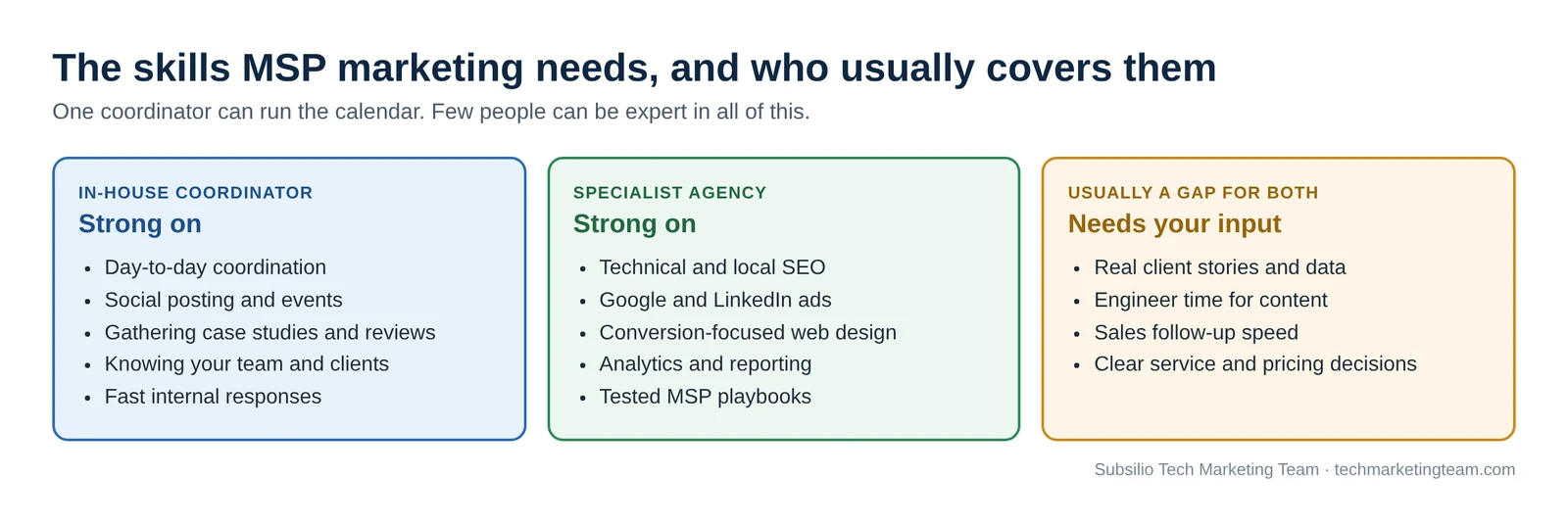
Neither option works without your input on real client stories and sales follow-up.
Side-by-side comparison
| Factor | In-house coordinator | Specialist MSP agency |
|---|---|---|
| Strategic breadth | Depends on one person’s experience | A team that has seen many MSP campaigns |
| Specialist depth | Usually a generalist | Separate specialists for SEO, ads, web, analytics |
| Ramp-up speed | Hiring plus onboarding, often several months | Faster start if they already know the MSP market |
| MSP and IT knowledge | Must learn your services from scratch | Already understands MSP buyers and terms |
| Knowledge of your business | Deep, and grows daily | Needs regular input from you |
| Tools and software | You buy and manage them | Usually included in the agency’s stack |
| Management time | You manage a person | You manage a relationship and reporting |
| Single point of failure | High: one resignation stops everything | Lower: work continues if one person leaves |
| Day-to-day availability | Instant, in the office | Scheduled, by agreement |
| Scaling up or down | Slow (hiring or letting go) | Easier to adjust scope |
Ramp-up time: the hidden cost of hiring
A new coordinator needs to be recruited, onboarded, trained on what managed IT and cybersecurity actually are, and given time to learn your clients and voice. Even a strong hire usually takes months before marketing produces steady results. During that time, the owner is often still the one making decisions.
A specialist agency that already works with MSPs skips most of the learning curve. It doesn’t skip the need for your input, though. Any agency that says it can market your MSP without talking to your engineers or clients will produce generic content.
The single-point-of-failure problem
MSPs warn their clients about key-person risk all the time: one IT person who knows every password. The same risk applies to a one-person marketing department.
- If your coordinator leaves, campaigns, logins and know-how can leave with them.
- Holidays and sick days pause everything.
- One person can’t cover SEO, ads and design during a busy month.
Whichever option you choose, make sure your company owns every account: your domain, website hosting, Google Business Profile, Google Ads, GA4, Search Console and social profiles. Give your coordinator or agency access to them; never let them own them.
The tools overhead
Doing MSP marketing well needs a stack of tools. With an in-house hire, your business chooses, pays for and manages them. A typical set includes:
- SEO and keyword research tools
- Rank tracking and local listings management
- Design and video software
- Email marketing and a CRM
- Social media scheduling
- Analytics dashboards and call tracking
Agencies usually spread these costs across many clients. That said, you should still own your core data, especially your CRM and analytics.
What about the cost?
Briefly: the U.S. Bureau of Labor Statistics puts the median pay for marketing specialists at $78,760 a year (May 2025). On top of salary, add benefits, tools, training and the owner’s management time. An agency retainer replaces most of that with one predictable fee, and the tools and specialist skills come with it.
When an in-house coordinator is the better choice
- You already have a clear marketing strategy and mainly need execution
- Events, partner relationships and community work are a big part of how you grow
- You need someone on-site to capture stories, photos and video from your team
- You have someone senior who can manage and coach a marketer
- You’re large enough to build a small team over time
When a specialist MSP agency is the better choice
- You need results from search and ads within months, not a year
- You don’t have a marketing leader to direct a junior hire
- You need several specialist skills, but not enough work to hire for each
- Your past hires were good at posting but not at producing leads (see the marketing trap most MSPs fall into)
- You want proven MSP approaches rather than learning by trial and error
The hybrid model
For many MSPs between roughly 15 and 100 staff, the best answer is both. An internal coordinator handles what needs inside knowledge, and an agency handles the specialist work.
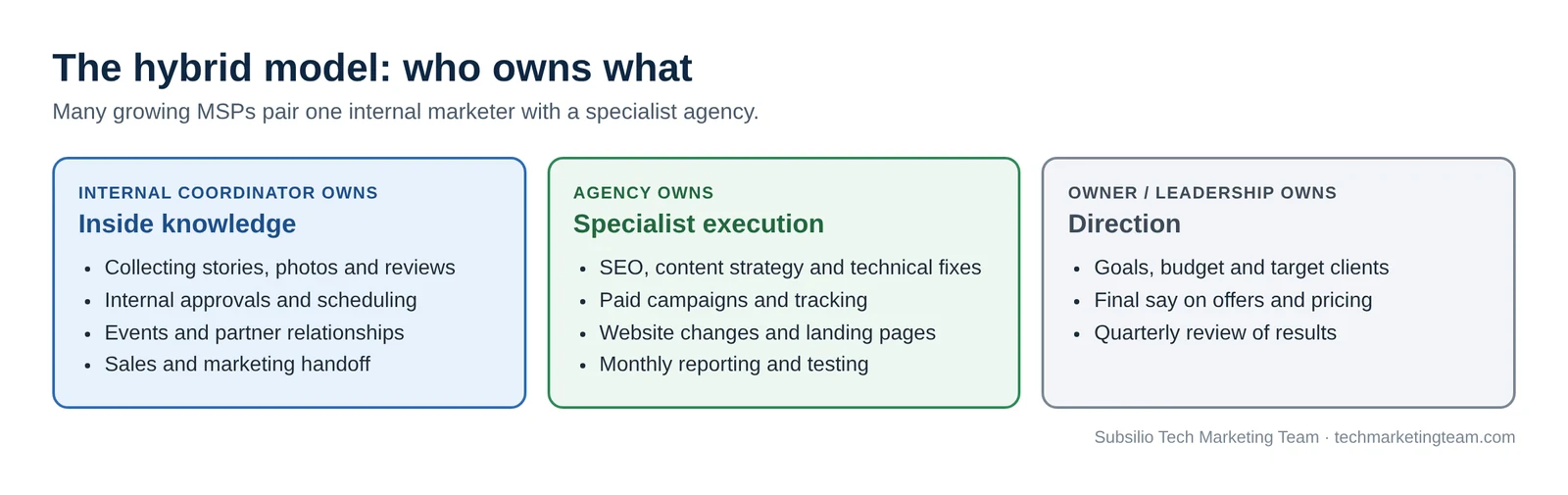
Clear ownership stops work falling between the coordinator and the agency.
The coordinator becomes the agency’s best source of real material: ticket stories, QBR insights, client wins and team photos. See how to turn tickets, QBRs and vCIO notes into SEO content. The agency turns that material into pages, campaigns and reports.
A quick decision checklist
Answer these honestly:
- Who will set the marketing strategy and targets?
- Which channels matter most to us right now: search, ads, LinkedIn, events or referrals?
- How soon do we need a steady flow of leads?
- Do we have someone who can manage and coach a marketing hire?
- What happens to our marketing if one person leaves?
- Who will own our accounts, data and website?
If your answers to 1 and 4 are “not sure” or “no one,” an in-house junior hire is likely to struggle on their own.
How to evaluate an MSP marketing agency
- Do they work with MSPs and IT companies, and can they show results?
- Who will actually do the work, and will you speak to them?
- What do monthly reports include: leads and revenue, or just traffic and rankings?
- Will you own all accounts, content and data?
- What are the contract terms and notice period?
- How will they get input from your engineers and clients?
You can see how we work on our about us page and in our client reviews.
If you hire in-house, set them up to succeed
- Write a clear role with three to five measurable goals
- Give them direct access to engineers and account managers for stories
- Budget for the tools they need from day one
- Pair them with outside specialists for SEO, ads or web work
- Review progress monthly and adjust
Final thoughts
The in-house versus agency choice isn’t really about cost. It’s about having the right skills, moving fast enough, and not depending on one person. An in-house coordinator brings closeness and continuity of knowledge. A specialist agency brings depth and speed. For many growing MSPs, the strongest setup combines both, with clear ownership and the business holding the keys.
Subsilio Tech Marketing Team works only with IT companies and MSPs, and often works alongside in-house coordinators. Book a free strategy call and we’ll help you work out which setup fits your stage of growth.
Frequently Asked Questions
Should an MSP hire a marketing coordinator or an agency?
It depends on what you need. A coordinator suits MSPs with a clear strategy that mainly need day-to-day execution and inside knowledge. An agency suits MSPs that need specialist SEO, ads and web skills quickly. Many growing MSPs use both.
What does an MSP marketing coordinator do?
Typically they manage the content calendar, social posting, events, case study and review collection, and coordination with sales and outside vendors. Most are generalists rather than SEO or paid-ads specialists.
How long does it take a new marketing hire to get results for an MSP?
Usually several months. They need time to learn managed IT and cybersecurity, understand your clients, and build a working content and campaign rhythm.
Can an in-house marketer and an agency work together?
Yes, and it often works well. The coordinator gathers stories and handles internal tasks, while the agency handles SEO, ads, web changes and reporting. Agree clearly on who owns what.
Who should own an MSP's marketing accounts?
The MSP itself. Your company should own the domain, website, Google Business Profile, Google Ads, GA4, Search Console and social profiles, and grant access to staff or agencies.
What should an MSP ask a marketing agency before hiring them?
Ask about their MSP experience and results, who will do the work, what reports include, who owns the accounts and data, contract terms, and how they will get input from your team.