


When MSP content underperforms, the diagnosis is almost always aimed at the wrong place. The writer gets blamed. The agency gets replaced. The topic gets called too competitive.
Nearly always, the failure happened earlier, at the brief. Or rather, at the absence of one. The typical MSP content instruction is a topic and a word count: “write 1,200 words on cloud backup.” That instruction contains no information about who is reading, what they already know, what decision they are making, what would move them forward, or what should happen at the end. So the writer produces something reasonable and generic, because a generic instruction cannot produce a specific piece.
The fix is a brief system organised around buyer stage. Not a template you fill in mechanically, but a discipline that forces the decisions to be made before anyone writes: which buyer, at which point in their thinking, needing what, moving where.
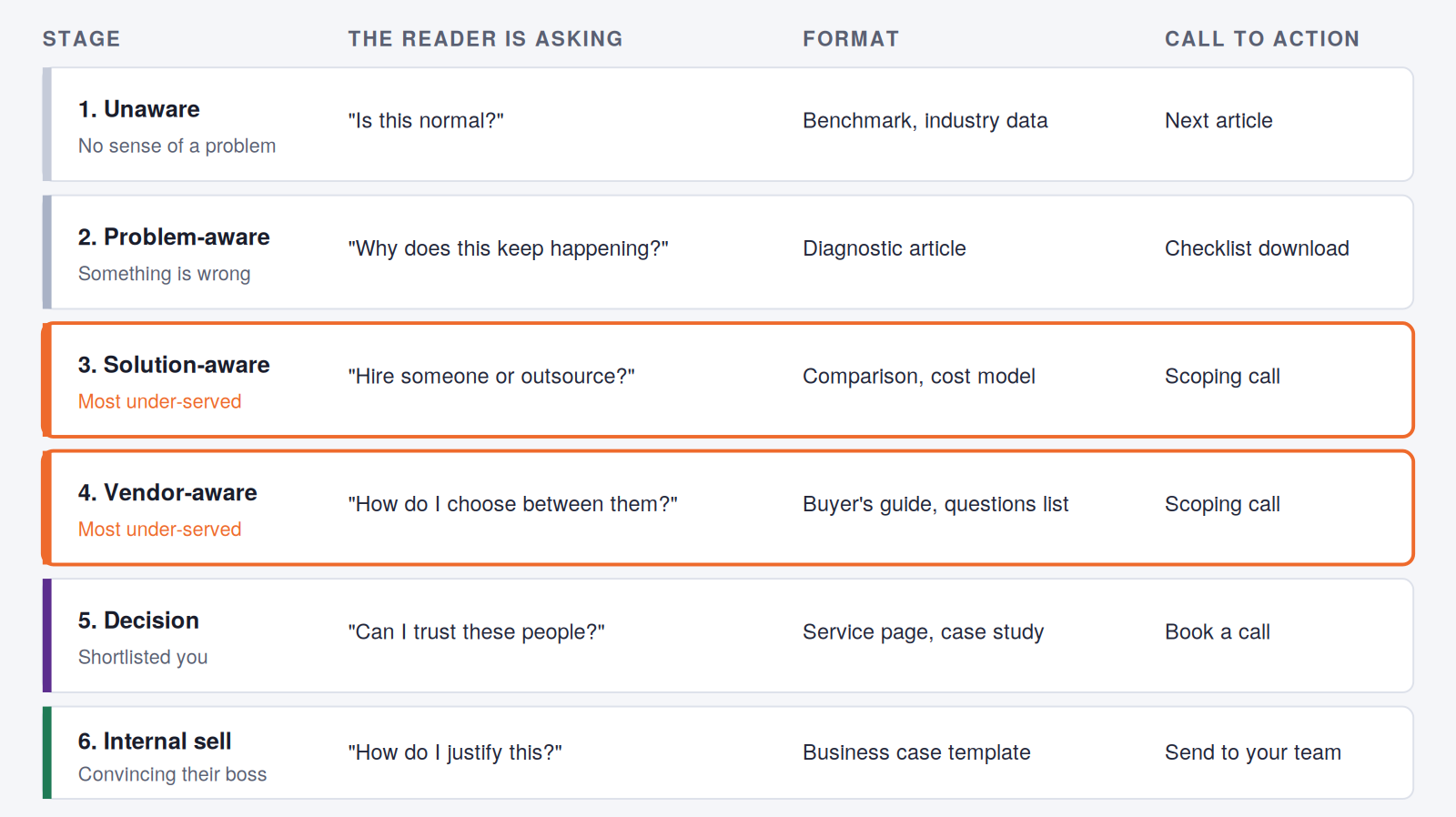
This guide sets out the six stages of the MSP buying journey, what content each requires, and a complete brief template for every one.
Why buyer stage is the right organising principle for MSPs
Most content frameworks sort by topic: cybersecurity content, cloud content, compliance content. That is how you catalogue a library, not how you build a pipeline.
Buyer stage is the better axis for MSPs for three reasons.
The MSP sales cycle is long and contains distinct gates. A business does not go from “our IT is annoying” to “sign here” in one motion. It moves through recognising a problem, deciding it needs solving, deciding to outsource rather than hire, choosing a provider, and getting internal approval. Each gate has different questions. Content that ignores which gate the reader is at will address the wrong ones.
Search intent maps to stage more reliably than to topic. “What is managed IT” and “managed IT provider Denver pricing” are the same topic and completely different searches. Sorting by topic puts them together. Sorting by stage keeps them apart, which is what the page structure needs.
It exposes the gaps in your library. Almost every MSP content audit we run shows the same shape: heavy at the awareness end, a reasonable set of service pages at the decision end, and almost nothing in between, where the buyer is deciding whether to outsource at all, and how to compare providers. That middle is where deals are won and where competitors are absent.
What every brief must specify, regardless of stage
Nine fields. If any is missing, the writer will invent it, and their invention will not match yours.
- The reader. Role, company size, industry, technical literacy. “Practice manager at a 40-person dental group, not technical, evaluating providers under time pressure” produces a different article from “IT buyer.”
- The stage, from the six above.
- The one question this page answers. A single sentence. If you cannot write it, the topic is not ready.
- The primary query and its variants, plus the related questions a reader would ask next. This matters technically as well as editorially, because Google’s AI features use query fan-out, generating related sub-queries behind the scenes and fetching results for each. A page that covers the adjacent questions properly performs better across that whole set.
- The specific evidence required. Not “include statistics” but “include the anonymised phishing failure rate across our client base, with sample size.” This field is what separates a page that gets cited from one that gets ignored.
- The internal expert. Who supplies the substance, who reviews it for accuracy, and whose name appears on it.
- The internal link plan. Which existing pages this links to, and which existing pages should be updated to link to it. Decide this at a brief stage; retrofitting internal links is a task nobody ever gets round to.
- The call to action, matched to stage. Asking a problem-aware reader to book a sales call is the most common conversion mistake in MSP content.
- What this page must not do. Usually: not become a sales pitch, not duplicate an existing page, not cover a topic reserved for another piece. This field prevents cannibalisation more effectively than any audit.
A useful discipline: write the meta description before the article, not after. If you cannot describe the value of the page in 155 characters, the page does not have a clear enough purpose yet, and no amount of drafting will fix that.
The six briefs
Stage 1: Unaware
The reader does not think they have a problem. They may not be searching for you at all. Content here works by making the invisible visible, usually through comparison to a norm.
Brief template: unaware stage
Reader: Business owner or operations lead, 20 to 150 staff, currently thinks their IT situation is normal
Question answered: “Is what we’re experiencing normal for a business our size?”
Format: Benchmark or industry data piece
Evidence required: Aggregated, anonymised data from your own client base with stated sample size and time period. This is non-negotiable: without original data this piece has no reason to exist
Must include: A comparison the reader can place themselves against; an explicit “here’s what this means if you’re above/below this”
Must not: Sell, mention your services beyond a single contextual line, or use fear framing
CTA: A related article, not a call. Keep the reader reading
Success measure: Referring links and citations, not conversions
Note the success measure. Unaware-stage content is a link and authority asset. Judging it on lead generation guarantees you will cancel it before it works.
Stage 2: Problem-aware
Something is visibly wrong. They are searching symptoms. This is the highest-volume stage and the one most MSP blogs already serve, usually badly, because the articles describe the problem without diagnosing it.
Brief template: problem-aware stage
Reader: Whoever has been landed with the problem, often an office manager or a finance lead, not a technician
Question answered: “Why does this keep happening and what do we do about it?”
Format: Diagnostic article, structured as symptom → common wrong assumption → actual causes → how to tell which → what to do
Evidence required: Real root-cause patterns from your service desk. State how often each cause turns out to be the culprit
Must include: A genuine self-diagnosis path the reader can follow without you; at least one cause they can fix themselves
Must not: Conclude that the only answer is hiring an MSP
CTA: A checklist or guide download; a call is premature
Success measure: Organic traffic, engagement depth, download rate
The instruction to include a fixable cause is deliberate and MSPs resist it. It is the highest-trust move available to you. A reader who solves a small problem using your article remembers where the help came from, and comes back with the large one.
Stage 3: Solution-aware
They know the problem needs solving properly. The live question is how: hire someone internally, use a part-time contractor, or engage a managed provider. This is the most commercially important underserved stage in MSP content.
Brief template: solution-aware stage
Reader: Decision-maker or strong influencer, budget-conscious, weighing structural options
Question answered: “Should we hire someone, use a contractor, or outsource?”
Format: Honest comparison with a cost model
Evidence required: Real total cost comparison including salary, benefits, recruitment, training, tools, holiday and sickness cover, and single-point-of-failure risk. Use realistic figures for their region
Must include: The scenarios where hiring internally is genuinely the right answer. There are several, typically above a certain headcount, or where highly specialised in-house systems exist
Must not: Pretend outsourcing always wins. The reader has already considered the alternative seriously; dismissing it destroys credibility
CTA: A scoping conversation, framed as help deciding rather than as a sales call
Success measure: Qualified enquiries
The “when hiring is right” section is what makes this piece work. Every competitor’s version of this article concludes that outsourcing is always better, which readers correctly discount as self-interested. Conceding the cases where you are not the answer is what makes the rest believable.
Stage 4: Vendor-aware
They have decided to outsource and are now comparing providers. They are looking for a way to tell you apart. Almost no MSP publishes anything for this stage, which means whoever does effectively sets the evaluation criteria.
Brief template: vendor-aware stage
Reader: Actively shortlisting two to four providers, probably has quotes already
Question answered: “How do I tell these providers apart and avoid choosing badly?”
Format: Buyer’s guide, or a list of questions to ask any provider
Evidence required: The specific things that differ between providers and that buyers usually fail to check: contract exit terms, whether response times are contractual or aspirational, what happens to their data if they leave, who actually answers the phone, how project work is priced versus included
Must include: Questions your own firm would find uncomfortable if a competitor answered them well. Write it so it is genuinely useful to someone who does not choose you
Must not: Reference or characterise named competitors
CTA: Scoping call, plus a downloadable version of the question list
Success measure: Qualified enquiries and sales-cycle length
The commercial logic here is worth stating plainly: whoever teaches the buyer how to evaluate the category tends to be evaluated favourably, because the criteria they taught are the ones they meet. This is the single highest-leverage piece of content most MSPs have never written.
Stage 5: Decision
They are on your shortlist. This is a trust and risk-reduction problem, and it is served by pages rather than articles: your service pages, case studies, pricing and about page.
Brief template: decision stage
Reader: Comparing you against one or two others, needs to de-risk the choice
Question answered: “Are these the right people, and what will actually happen if we sign?”
Format: Service page or case study
Evidence required: Named reviews, certifications you hold, specific outcomes with context, named team members with credentials
Must include: Scope boundaries including exclusions; a pricing signal; the onboarding timeline; what their team has to do
Must not: Use unsupported superlatives, or hide the exclusions
CTA: A specifically described call: duration, agenda, attendees, what they receive
Success measure: Conversion rate and enquiry quality
Stage 6: Internal sell
The most neglected stage of all. Your contact is convinced. They now have to persuade an owner, a board or a finance director who has not read any of your content and does not want to spend the money.
Brief template: internal sell stage
Reader: Your champion, who will forward this to someone more sceptical
Question answered: “How do I justify this internally without being the person who overspent on IT?”
Format: Business case guide or template
Evidence required: A cost-of-inaction framing that is specific about mechanism rather than emotive; realistic payback framing; the questions a CFO will ask
Must include: Language they can lift directly; an acknowledgement of the objections they will face; a one-page summary format
Must not: Read as marketing material. It will be forwarded, and it needs to survive being read by a sceptic
CTA: “Send this to your finance lead”: the share is the conversion
Success measure: Sales-cycle length and close rate, not traffic
Balancing the library
Once every piece is tagged by stage, run a simple count of what you have. The distribution we recommend for MSPs, and the one we almost never find in place:
| Stage | Typical MSP library (percent) | Recommended (percent) |
|---|---|---|
| 1. Unaware | 15 | 10 |
| 2. Problem-aware | 60 | 30 |
| 3. Solution-aware | 5 | 20 |
| 4. Vendor-aware | 2 | 15 |
| 5. Decision | 18 | 20 |
| 6. Internal sell | 0 | 5 |
The pattern is consistent: heavy at the top, hollow in the middle. Rebalancing towards stages three and four usually produces faster commercial results than publishing anything new at stage two, because those pages meet readers who are weeks rather than months from a decision, and because almost nobody else is there.
Making briefs hold up on quality
Two additions turn a good brief into one that produces content capable of ranking and being cited.
Name the evidence, not the topic. Google’s guidance on creating helpful, people-first content centres on whether a page demonstrates first-hand experience and offers something beyond common knowledge. A brief that says “write about backup” cannot produce that. A brief that says “use our recovery time data across 30 restores, with the three most common failure points we found” can.
Name the human. Specify who supplies the substance and whose byline appears. Anonymous content signals nothing about expertise, and it deprives you of the one advantage you have over a generic competitor: that a real engineer with real credentials stands behind the claim.
For where the raw material comes from, see our guide to turning tickets, QBRs and vCIO notes into SEO content. For how the resulting pages should be wired together, see MSP website architecture. And for why consistency beats bursts, the marketing trap most MSPs fall into covers the pattern this system is designed to prevent.
Running the system
Keep it light or it will not survive contact with a busy quarter.
- One brief document per piece, no longer than a page, filled in before anything is commissioned
- A stage tag on every existing page so the gap analysis takes minutes rather than a day
- A quarterly review of stage distribution against the table above
- One owner who can approve a brief without a committee
- A standing rule: nothing gets written without a completed brief. The rule matters more than the template
The wider planning discipline this sits inside is covered in how strategic planning is revolutionising MSP success.
The point of all this
A content brief is not administrative overhead. It is where the thinking happens. Every decision the brief forces (which reader, which stage, which evidence, which next step) is a decision that would otherwise be made silently by a writer who does not have the information to make it well.
MSPs who adopt this find the same thing: they publish less, and it works better. Because the constraint was never volume. It was that nobody had decided what any given piece was actually for.
Want a content system built around your buyers, not a topic list?
We plan, brief and produce content for IT providers and MSPs: mapped to buyer stage, sourced from your own operational expertise, and measured against qualified enquiries.
Book a free strategy call or explore our MSP SEO services.
What should an MSP content brief include?
Nine elements: the specific reader with role, company size and technical literacy; the buyer stage; the single question the page answers; the primary query and related questions; the specific evidence required from your own operations; the internal expert supplying and reviewing the substance; the internal link plan in both directions; the call to action matched to stage; and an explicit list of what the page must not do. That last field prevents keyword cannibalisation more effectively than any audit.
What are the buyer stages for MSP marketing?
Six: unaware, where the buyer does not perceive a problem; problem-aware, where symptoms are visible; solution-aware, where they are deciding between hiring internally, using a contractor or outsourcing; vendor-aware, where they are comparing providers; decision, where they are shortlisting and de-risking; and internal sell, where your champion has to justify the spend to someone else. Stages three and four are where most MSP libraries are empty.
How much content should an MSP have at each stage?
As a working target, roughly 10 percent unaware, 30 percent problem-aware, 20 percent solution-aware, 15 percent vendor-aware, 20 percent decision and 5 percent internal sell. Most MSP libraries are heavily skewed towards problem-aware content with almost nothing at solution-aware and vendor-aware. Rebalancing towards those two usually produces faster commercial results than adding more top-of-funnel articles.
Should MSP blog posts always end with a call to book a call?
No, and doing so is one of the most common conversion mistakes in MSP content. A problem-aware reader who has just arrived is not ready for a sales conversation, and pushing one loses them. Match the ask to the stage: another article for unaware readers, a checklist or guide for problem-aware, a scoping conversation for solution-aware and vendor-aware, and a specific described call at decision stage.
Should we admit when hiring in-house is better than using an MSP?
Yes. It is the single most credibility-building move available in solution-aware content. Readers have already considered the alternative seriously, and an article concluding that outsourcing always wins is correctly discounted as self-interested. Conceding the genuine cases where an internal hire is the right answer (typically above a certain headcount, or where highly specialised in-house systems exist) is what makes the rest of your argument believable.
What is a vendor-aware buyer's guide and why does it matter?
It is a piece of content that teaches a buyer how to evaluate managed service providers: what to ask, what differs between firms, and what buyers usually fail to check. It matters because whoever sets the evaluation criteria tends to be evaluated favourably, and because almost no MSPs publish anything at this stage. Written honestly, so that it is useful even to someone who chooses a competitor, it is often the highest-leverage single page an MSP can produce.
How does query fan-out affect content briefs?
Google’s AI features generate related sub-queries behind the scenes and fetch results for each, so a page that thoroughly covers the adjacent questions a reader would ask next performs better across that whole set. Briefs should therefore list the related questions, not just the primary query. This is not a reason to create separate pages for every phrasing variation, because Google warns that doing so primarily to influence rankings falls under its scaled content abuse policy.
How long should MSP content briefs be?
One page. A brief long enough to require its own reading time will not get filled in during a busy quarter, and the system dies. The value is in forcing nine specific decisions, not in documenting them extensively. The standing rule that nothing gets written without a completed brief matters far more than the elaborateness of the template.