



Link building is the part of MSP SEO where most agencies quietly give up and start buying.
The reason is structural. Consumer local businesses have natural link paths: a restaurant gets covered by the local food blog, a gym sponsors the youth league, a dentist appears in a “best of” roundup. An MSP has none of that. Nobody writes a listicle about the best managed service providers in your county. Nobody links to your patch management page because they enjoyed it. Your clients cannot talk publicly about their infrastructure. And your buyers are business owners who do not run blogs.
So the market fills with link vendors selling packages of guest posts on sites nobody reads, directory submissions to link farms, and “authority building” that is a network of the same forty domains sold to every MSP in the country. That approach ranged from ineffective to actively harmful five years ago. Today, with link spam detection folded into Google’s core systems, it is mostly just harmful.
There is a real path, though, and it is one MSPs are unusually well positioned to walk, because MSPs are embedded in local business communities in ways that most B2B service firms are not. This guide covers the link sources that genuinely work, the workflow to pursue them, how to handle sponsorships and directories without breaking guidelines, and what to stop doing today.
What local links actually do for an MSP
Be clear about the mechanism before you spend money on it, because MSPs are frequently sold link building for the wrong reason.
Links do three distinct jobs:
- They pass ranking signals to specific pages. A link to your homepage helps your whole domain a little. A link to your Denver location page helps that page a lot. Most MSP link building points everything at the homepage and wastes the leverage.
- They establish local relevance, not just authority. For local search, a link from a genuinely local, topically adjacent site (a chamber, a local business association, a nearby firm’s partner page) carries relevance signals that a high-authority national site does not. Local relevance is the scarce resource, not raw domain metrics.
- They build the entity picture that AI systems draw on. When a language model is asked which IT providers serve a city, it is drawing on how your business is described and referenced across the web. Links come with context: the sentence around them, the page they sit on, the organisation doing the linking. That surrounding context matters increasingly as much as the link itself.
Note the last one carefully, and note its limit. Google is explicit in its generative AI optimisation guidance that chasing inauthentic “mentions” across the web is not as helpful as it sounds, because the same systems that block spam also feed the AI features. Real relationships produce useful mentions. Manufactured ones produce liability.
The link sources that work for MSPs
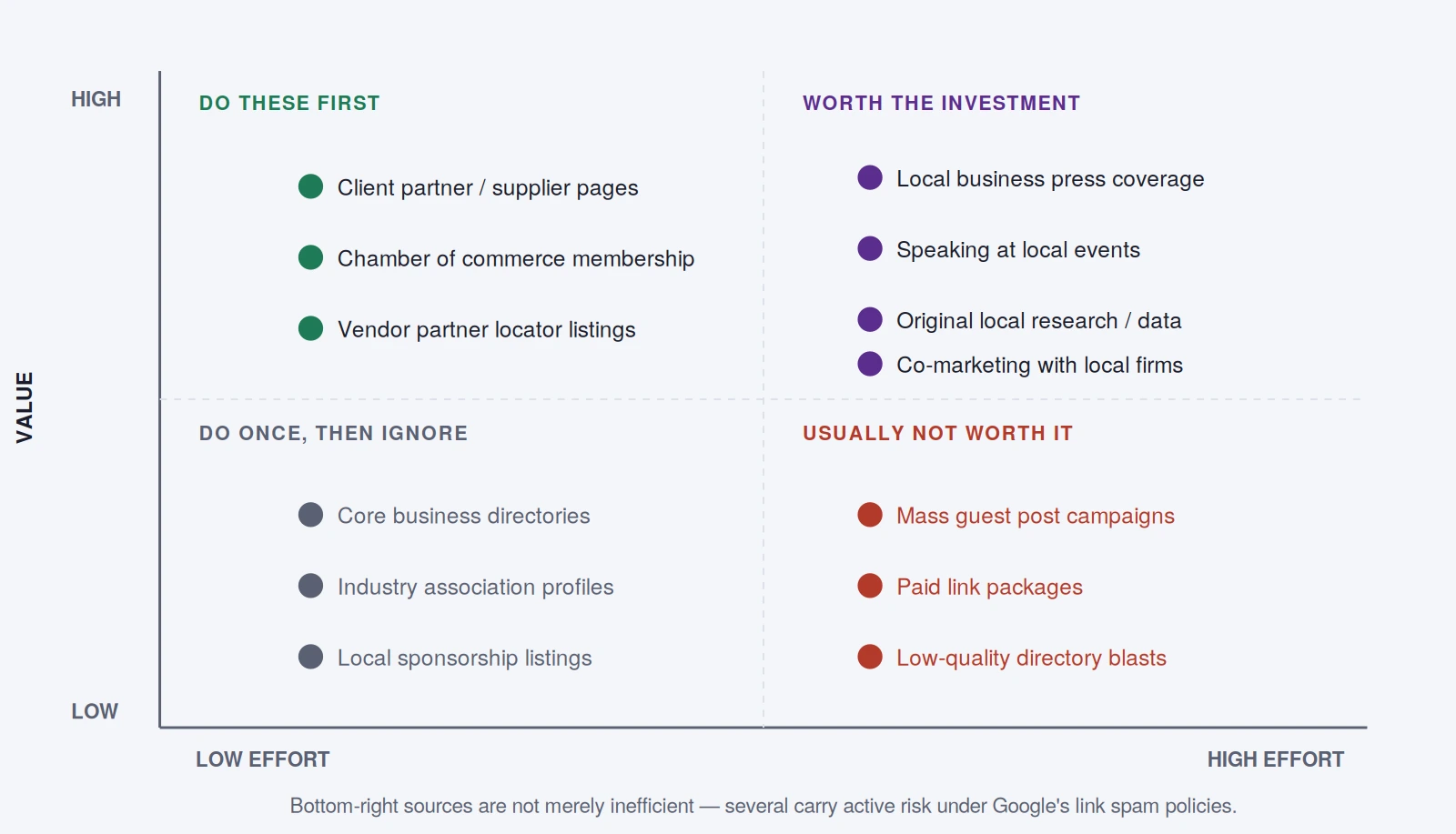
Plotted by effort against value, MSP link opportunities fall into fairly predictable places.
1. Your own clients, the most under-used source in the industry
You have dozens of local business clients. Many of them have a “partners,” “suppliers” or “who we work with” page. Many more have an “about” page that could reasonably mention who handles their technology. Almost none of them link to you, because nobody has ever asked.
The ask is simple and should be built into your onboarding: at the end of a successful first 90 days, ask whether they would be happy to list you as their technology partner on their website, and offer to supply the logo, the wording and a link. Roughly a third will say yes, more if the relationship is good.
These links are excellent. They are local, they are from real businesses in your service area, they sit in a relevant context, and they cannot be bought by a competitor. One caution: keep it genuinely voluntary and unincentivised. Offering a discount in exchange for a link turns it into a link scheme under Google’s spam policies. Ask because you earned it, not because you paid for it.
2. Chambers of commerce and local business associations
Chamber membership is one of the few directory-style links that remains genuinely valuable, because it is paid for a real membership with real benefits and the directory is a legitimate business function rather than a link product. Most MSPs already belong to one and have never checked whether their profile actually contains a link, whether it is followed, or whether their NAP details match the rest of their footprint.
Beyond the base membership, chambers offer far more than a directory entry: member spotlight features, event speaking slots, newsletter contributions, and committee positions that come with a bio page. Those produce contextual links and, more importantly, the relationships that produce everything else on this list.
3. Vendor and partner ecosystems
Every vendor you hold a partnership with likely runs a partner locator or directory. These are underused because MSPs complete the minimum profile and move on. Fill them out completely, use consistent NAP data, link to a relevant page rather than always the homepage, and check annually, partner directories change platforms often and links break silently.
4. Local sponsorship, done properly
Sponsorship is the tactic most likely to get an MSP into trouble, and also a legitimate one when handled correctly. The distinction is intent and disclosure.
Sponsoring a youth sports team, a local charity run, a business awards evening or a school technology programme is a normal community activity that often results in a listing with a link. That is fine. What is not fine is buying sponsorships purely for links, particularly from organisations with no connection to your area, or in bulk. If you would sponsor it anyway, take the link. If the only reason you are considering it is the link, walk away, and if there is any doubt about whether the payment is essentially for the link, the correct handling is to have it qualified with rel=”sponsored”, as set out in Google’s guidance on qualifying outbound links.
5. Local press and business journals
Regional business journals are perpetually short of substance and MSPs sit on a lot of it. What works: commenting on a local incident or outage with genuine technical insight, publishing regional data nobody else has, announcing a genuinely newsworthy hire or expansion, and being the person a reporter can call at short notice for a quote about a technology story.
That last one is worth building deliberately. Identify the two or three journalists who cover business and technology in your region, follow their work, and respond usefully when they need a source: quickly, in plain language, with something quotable. Reporters keep lists of people who make their job easier. Getting onto that list produces coverage repeatedly, for years.
6. Original local data
The strongest linkable asset an MSP can build is a piece of regional research that does not exist anywhere else. Aggregated, anonymised findings from your own client base (the state of technology spend in your metro area, phishing susceptibility rates by industry locally, average age of infrastructure in businesses of a given size) give local journalists, chambers and business groups something to cite.
This connects directly to the operational content pipeline described in our guide to turning tickets, QBRs and vCIO notes into SEO content. The same anonymised data that makes strong blog content makes the strongest link asset you will ever own.
7. Co-marketing with non-competing local firms
Accountants, law firms, HR consultancies, commercial insurance brokers and business coaches all serve the same buyers you do and compete with you for nothing. A jointly hosted webinar, a co-authored guide on a shared concern like cyber insurance requirements, or a genuine referral partnership produces mutual links, shared audiences and, usually more valuable than the links, actual referrals.
The workflow: how to run this without it eating your week
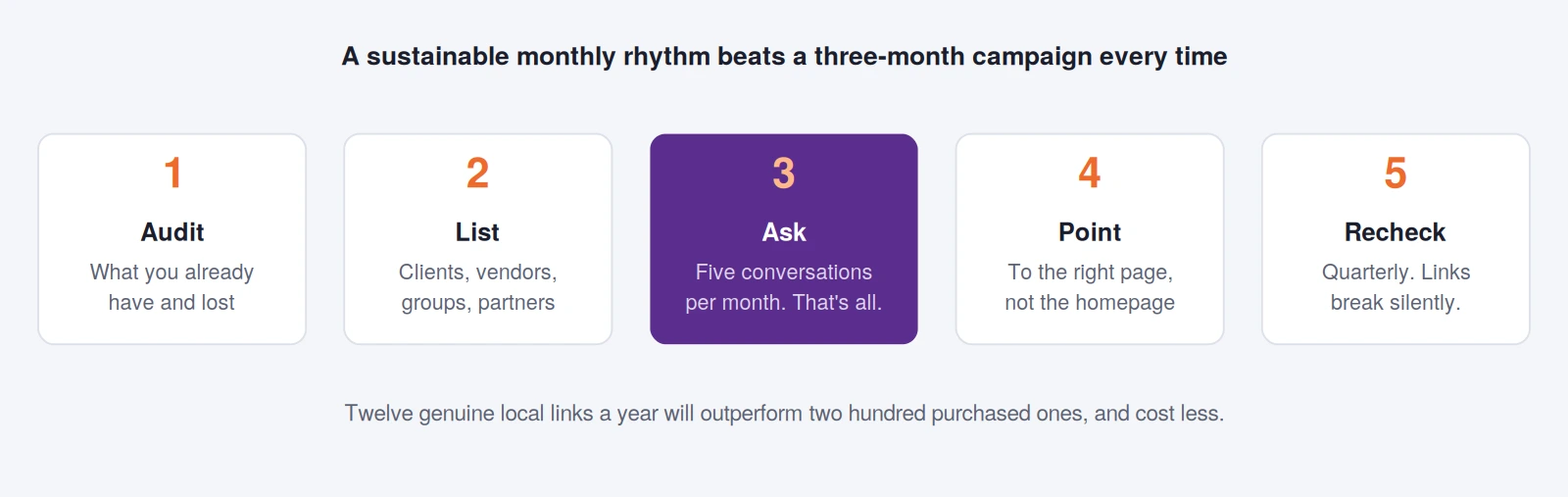
Point links at the right page
This is where most MSPs waste the value they earn. If you have location pages, a chamber in that city should link to that city’s page. If you sponsored an event connected to a particular service, link to that service page. Every link that lands on the homepage when it could have landed on a commercial page is leverage thrown away.
This only works if your page structure supports it. Our guides to MSP website architecture and service-area pages without doorway-page spam cover how to build the destinations worth linking to in the first place.
Vary the anchor text naturally
Exact-match anchors repeated across dozens of links is one of the clearest footprints of a manipulated profile. Real links use your business name, the URL, or a natural phrase in a sentence. Do not send partners a specific anchor to use. Send them your name and the right URL and let them write their own sentence.
Recheck quarterly
Local links decay fast. Chambers migrate platforms, clients redesign websites, event pages get archived, vendor directories get rebuilt. A quarterly check of every link you have earned typically recovers several that broke without anyone noticing, and recovering an existing link is far cheaper than earning a new one.
What to stop doing immediately
These carry real risk under Google’s link spam policies, which are now part of core ranking systems rather than a periodic update:
Paid link packages. Any service selling a number of links per month for a fixed fee is selling link scheme participation, regardless of how it is described.
Mass guest posting. Large-scale article campaigns with keyword-rich anchors are explicitly named as a violation. A genuine contributed article to a publication your buyers actually read is a different thing entirely.
Private blog networks. There is no version of this that is safe, and MSP-focused networks are unusually easy to identify because the same sites link to hundreds of MSPs.
Directory blasts. Submission to hundreds of low-quality directories does nothing positive and creates a visible footprint.
Reciprocal link pages. “Partner links” pages that exist only to trade links are an old tactic that still gets sold to MSPs.
Paying clients for links. Discounts or credits in exchange for a link converts a legitimate relationship into a link scheme.
If you have inherited a profile containing these, focus first on stopping the flow and building genuine links to dilute it. The disavow tool exists but is rarely the right first move, Google’s systems already discount most low-quality links automatically.
How to measure it without fooling yourself
Link building is where vanity metrics do the most damage. Domain-authority style scores from third-party tools are estimates built on those tools’ own crawls; they are useful for comparison and useless as a target. Track outcomes instead:
- Referring domains, not links. Fifty links from one site is one relationship.
- Local relevance of the referring domain. Is it in your service area or serving your buyers?
- Ranking movement on the specific pages you pointed links at. This is the only causal signal you have.
- Referral traffic and its quality. A chamber link that sends four visitors a month who convert at 25 percent is worth more than any metric suggests.
- Local pack visibility over time for your priority city terms.
For how to set this measurement up properly across Search Console and GA4, see our guide to measuring MSP SEO and AI visibility. And if your local visibility problem runs deeper than links, why your MSP is invisible on Google covers the other common causes, while our Google Business Profile operating checklist handles the local foundation that links amplify.
The honest summary
Local link building for MSPs is slow, relationship-driven, and impossible to scale, which is precisely why it works. Every source on the “do this” side of the matrix requires something a competitor cannot buy: a client who likes you enough to say so publicly, a chamber where people know your name, a journalist who has your number, data that only your operation could produce.
Twelve links like that in a year will beat two hundred purchased ones, cost less, carry no risk, and generate referrals as a side effect. The reason so few MSPs have them is not that they are hard to get. It is that nobody has asked.
Need a local link strategy that won’t put your site at risk?
We build local authority for IT providers and MSPs through real relationships, earned coverage and original data, not link packages.
Book a free strategy call or explore our MSP SEO services.
How many backlinks does an MSP need to rank locally?
There is no threshold number, and any agency quoting one is guessing. What matters is the relevance and legitimacy of the referring domains rather than the count. In competitive metros, MSPs ranking well in the local pack typically have links from a modest number of genuinely local, genuinely relevant sources (chambers, clients, vendor directories, local media) rather than large volumes of generic links. One to two earned local links per month, sustained, puts most MSPs ahead of their local competition within a year.
Are chamber of commerce links good for SEO?
Yes, when they come with real membership. Chamber directories are legitimate business listings rather than link products, they are genuinely local, and they are topically adjacent to your buyers. Check that your profile actually contains a link, that it is not blocked from crawling, and that your name, address and phone number match your other listings exactly. The bigger opportunity is usually beyond the directory entry: member features, speaking slots and newsletter contributions produce stronger contextual links.
Can I ask my clients to link to my MSP website?
Yes, provided the request is voluntary and unincentivised. Many businesses have a partners or suppliers page and will happily list their technology provider if asked. Build the request into your 90-day check-in and offer to supply the logo and the right URL. Do not offer discounts, credits or anything of value in exchange, as that converts a legitimate relationship into a link scheme under Google’s spam policies.
Is sponsoring local events good for link building?
It is legitimate when the sponsorship is a genuine community activity you would undertake regardless of the link. It becomes a problem when sponsorships are bought purely for links, in bulk, or from organisations with no connection to your area. Where a payment is essentially in exchange for a link, the link should be qualified with rel=”sponsored”. A useful test: if you would still do it with no link at all, take the link.
Do guest posts still work for MSP link building?
A genuine contributed article to a publication your buyers actually read, written by a named expert on your team, is valuable. Mass guest posting campaigns across low-quality sites with keyword-rich anchor text are explicitly named as a link spam violation and carry real risk. The distinction is whether the article would be worth publishing if the link were removed.
Should I use the Google disavow tool if I inherited bad links?
Usually not as a first step. Google’s systems automatically discount most low-quality links without any action from you, and careless disavowing can remove links that were helping. Focus first on stopping any ongoing paid or manipulative link acquisition, then build genuine links to dilute the profile. Disavow is best reserved for cases involving a manual action or a clearly identifiable, deliberate attack.
Do backlinks help my MSP appear in AI search results?
Indirectly. AI features in Google Search are grounded in the search index, so anything improving your standing there can improve eligibility. But Google states plainly that seeking inauthentic mentions across the web is less helpful than it appears, because the same systems that block spam also feed the AI features. Genuine coverage, real relationships and original data build the entity picture AI systems draw on. Manufactured mentions create risk without benefit.
What anchor text should local links use?
Whatever the linking site naturally chooses. Repeated exact-match commercial anchors across many links is one of the clearest signals of a manipulated profile. Natural profiles are dominated by brand names, URLs and phrases embedded in sentences. Give partners your business name and the correct URL, and let them write their own wording.